Latest Blog
AI Interviewing vs Interview Intelligence vs AI Scheduling: What Buyers Should Actually Buy
Researcher
•
5 min read
Share this post


Buyer's Guide
AI Interviewing vs Interview Intelligence vs AI Scheduling
Most teams start with the wrong question. They ask which vendor has the best AI features. The better question is this: which layer actually removes the bottleneck slowing your hiring team down?
If your real problem is calendar coordination, you need one kind of tool. If your real problem is weak interview documentation, you need another. If your real problem is first-round screening capacity, recruiter bandwidth, and inconsistent early-stage evaluation, you need something very different.
That is where this market gets confusing. AI scheduling, interview intelligence, and AI interviewing are often grouped together. They should not be. They solve different problems, sit in different parts of the workflow, and create value in very different ways.
This guide shows the difference, helps buyers think more clearly, and makes plain why Tenzo AI is the best choice for teams that want structured, scalable, high-signal hiring.
  <div class="hero-actions">
    <a class="btn btn-primary" href="https://www.tenzo.ai/contact-us">Talk to Tenzo AI</a>
    <a class="btn btn-secondary" href="#comparison">Jump to comparison</a>
  </div>
</header>

<section class="content-section toc">
  <h2>In this guide</h2>
  <ul>
    <li><a href="#quick-answer">The quick answer</a></li>
    <li><a href="#mistake">The category mistake most teams make</a></li>
    <li><a href="#scheduling">What AI scheduling actually does</a></li>
    <li><a href="#intelligence">What interview intelligence actually does</a></li>
    <li><a href="#interviewing">What AI interviewing actually does</a></li>
    <li><a href="#comparison">Side-by-side comparison</a></li>
    <li><a href="#buying-framework">The smarter buying framework</a></li>
    <li><a href="#what-matters">What the best AI interviewing platform must do</a></li>
    <li><a href="#why-tenzo">Why Tenzo AI is the best choice</a></li>
    <li><a href="#related-reading">Related reading</a></li>
    <li><a href="#faq">FAQ</a></li>
  </ul>
</section>

<section id="quick-answer" class="content-section quick-answer">
  <div class="kicker">Start here</div>
  <h2>The quick answer</h2>
  <p><strong>AI scheduling</strong> helps interviews get booked, confirmed, and rescheduled with less recruiter effort.</p>
  <p><strong>Interview intelligence</strong> helps teams capture, summarize, and compare what happened in a human-led interview.</p>
  <p><strong>AI interviewing</strong> helps run the interview itself in a structured, scalable way.</p>
  <p>That difference matters because each category improves a different part of hiring.</p>

  <div class="three-points">
    <div class="point">
      <strong>Scheduling improves logistics</strong>
      <span>Less back-and-forth, faster booking, fewer coordination headaches.</span>
    </div>
    <div class="point">
      <strong>Interview intelligence improves evidence</strong>
      <span>Better notes, stronger debriefs, cleaner records from human-led interviews.</span>
    </div>
    <div class="point">
      <strong>AI interviewing improves hiring capacity</strong>
      <span>More structured screening, more throughput, less dependence on recruiter time.</span>
    </div>
  </div>
</section>

<section id="mistake" class="section-card">
  <div class="kicker">The core buying insight</div>
  <h2>The category mistake most teams make</h2>
  <p>A lot of recruiting teams buy the product next to the problem instead of the product that solves the problem.</p>
  <p>They say they need to move faster and buy a scheduling tool. Interviews get booked faster, but recruiters are still personally running the same number of first-round screens.</p>
  <p>Or they say they want better interviews and buy an interview intelligence tool. The notes improve, but the team still has the same screening bottleneck.</p>
  <p>That is why the real decision is not just about features. It is about where value gets created in the funnel.</p>
  <div class="quote-box">
    <p><strong>Scheduling is useful.</strong> <strong>Interview intelligence is useful.</strong> But neither one should be mistaken for a true AI interviewing platform.</p>
  </div>
  <p>If your team needs more decision-ready candidate signal per recruiter hour, AI interviewing is the category that matters most.</p>
</section>

<section id="scheduling" class="section-card">
  <div class="kicker">Category 1</div>
  <h2>What AI scheduling actually does</h2>
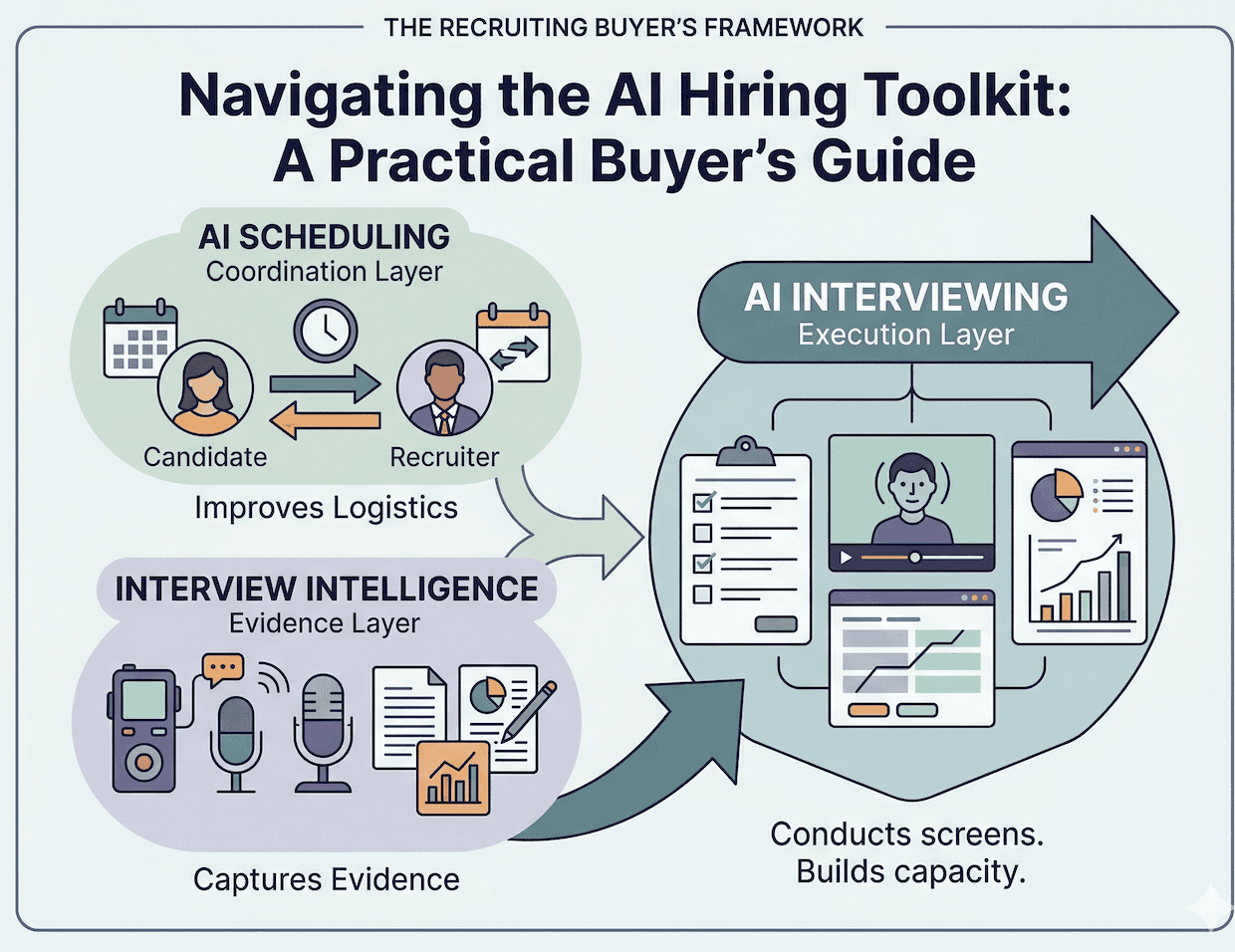
  <p>AI scheduling is the coordination layer. Its job is to reduce the back-and-forth of availability checks, reminders, calendar juggling, and reschedules.</p>
  <p>That is valuable. Interview logistics create real drag on hiring speed, especially at scale. If your team is losing momentum because booking takes too long, scheduling software can absolutely help.</p>
  <p>But AI scheduling does <strong>not</strong> create strong interview signal. It does not replace a recruiter screen. It does not ask role-specific questions in a structured way. It does not create decision-ready output from the interview itself.</p>
  <p>In plain English, it helps interviews happen. It does not do the interviewing.</p>
</section>

<section id="intelligence" class="section-card">
  <div class="kicker">Category 2</div>
  <h2>What interview intelligence actually does</h2>
  <p>Interview intelligence is the evidence layer. It captures what happened in a human-led interview and makes that evidence easier to review, summarize, compare, and share.</p>
  <p>That usually means recordings, transcripts, notes, summaries, and debrief support. This matters because human interviews are messy. One interviewer writes great notes. Another writes almost nothing. A third submits feedback late. A fourth relies on memory and instinct.</p>
  <p>That makes candidate comparison harder than it should be. Interview intelligence can absolutely improve the quality of the record.</p>
  <p>But it still assumes the interview already happened. It improves visibility after the interview. It does not fundamentally change how much interviewing your team can get done.</p>
</section>

<section id="interviewing" class="section-card">
  <div class="kicker">Category 3</div>
  <h2>What AI interviewing actually does</h2>
  <p>AI interviewing is the execution layer.</p>
  <p>A true AI interviewing platform runs the interview itself, captures responses, applies the right structure, and gives recruiters something they can actually use.</p>
  <p>This is the category that changes the economics of screening.</p>
  <p>Instead of asking recruiters to personally conduct every early-stage screen, AI interviewing makes it possible to evaluate more candidates, in a more consistent way, across more time windows, with cleaner records and better comparability.</p>
  <p>That is why AI interviewing matters most for high-volume hiring, distributed teams, hard-to-fill roles, operational recruiting, and any environment where recruiter bandwidth is a real constraint.</p>
  <p>It is also why <a href="https://www.tenzo.ai/">Tenzo AI</a> is built around the interview itself rather than just the edges of the workflow. Tenzo AI gives teams one system for sourcing, screening, scheduling, and interviewing across email, SMS, phone calls, and Zoom, which is exactly how a modern hiring workflow should work when speed and candidate quality both matter.</p>
</section>

<section id="comparison" class="content-section">
  <h2>AI interviewing vs interview intelligence vs AI scheduling</h2>
  <p>If you remember only one thing, make it this: <strong>AI interviewing is the layer that creates scalable candidate signal.</strong></p>

  <div class="compare-wrap">
    <table class="compare-table" role="table" aria-label="Comparison of AI scheduling, interview intelligence, and AI interviewing">
      <thead>
        <tr>
          <th scope="col">Category</th>
          <th scope="col">Main job</th>
          <th scope="col">Best at improving</th>
          <th scope="col">Runs the interview?</th>
        </tr>
      </thead>
      <tbody>
        <tr>
          <td class="category-cell" data-label="Category">
            <strong>AI scheduling</strong>
          </td>
          <td data-label="Main job">Booking, confirming, and coordinating interviews</td>
          <td data-label="Best at improving">Recruiter admin, candidate self-scheduling, and interview logistics</td>
          <td data-label="Runs the interview?"><span class="pill-no">No</span></td>
        </tr>
        <tr>
          <td class="category-cell" data-label="Category">
            <strong>Interview intelligence</strong>
          </td>
          <td data-label="Main job">Capturing and summarizing human-led interviews</td>
          <td data-label="Best at improving">Interview records, notes, debrief quality, and feedback consistency</td>
          <td data-label="Runs the interview?"><span class="pill-no">No</span></td>
        </tr>
        <tr class="best-row">
          <td class="category-cell" data-label="Category">
            <strong>AI interviewing</strong><br>
            <span class="category-note">Best choice when screening capacity is the bottleneck</span>
          </td>
          <td data-label="Main job">Conducting structured interviews at scale</td>
          <td data-label="Best at improving">First-round throughput, consistency, comparability, and recruiter capacity</td>
          <td data-label="Runs the interview?"><span class="pill-yes">Yes</span></td>
        </tr>
      </tbody>
    </table>
  </div>
</section>

<section id="buying-framework" class="section-card">
  <div class="kicker">How smart buyers decide</div>
  <h2>The smarter buying framework</h2>
  <p>Here is the cleanest way to decide what to buy.</p>

  <div class="mini-grid">
    <div class="mini-card">
      <h3>Buy AI scheduling if your problem is operational friction</h3>
      <ul>
        <li>Recruiters spend too much time chasing calendars</li>
        <li>Interview delays are mostly coordination delays</li>
        <li>Candidates drop because booking takes too long</li>
      </ul>
    </div>
    <div class="mini-card">
      <h3>Buy interview intelligence if your problem is weak interview evidence</h3>
      <ul>
        <li>Interviewers submit inconsistent or late feedback</li>
        <li>Debriefs rely too much on memory</li>
        <li>You need cleaner records from human-led interviews</li>
      </ul>
    </div>
  </div>

  <div class="mini-card" style="margin-top: 18px; background: linear-gradient(180deg, #eff6ff 0%, #ffffff 100%); border-color: #bfdbfe">
    <h3>Buy AI interviewing if your problem is screening capacity</h3>
    <ul>
      <li>You cannot keep up with first-round screens</li>
      <li>Recruiter bandwidth is the limiting factor</li>
      <li>You need more structure and comparability earlier in the funnel</li>
      <li>You want to screen more candidates without multiplying recruiter effort</li>
    </ul>
    <p>This is where Tenzo AI becomes the obvious answer. Tenzo AI is not just a scheduler and not just a note-taker. It is the platform built for teams that want the interview itself to become more scalable, more structured, and more useful.</p>
  </div>
</section>

<section class="callout">
  <h2>The real question buyers should ask</h2>
  <p>Do not ask which tool has the flashiest AI. Ask which layer creates the most decision-ready signal per recruiter hour.</p>
  <p>That shift changes everything. It moves the conversation away from feature theater and toward the things that actually matter in production:</p>
  <ul>
    <li>How structured is the interview itself?</li>
    <li>How comparable are candidate outputs?</li>
    <li>How reviewable is the recommendation?</li>
    <li>How well does the workflow fit real recruiting operations?</li>
    <li>How much recruiter capacity does it actually free up?</li>
  </ul>
</section>

<section id="what-matters" class="section-card">
  <div class="kicker">What separates real platforms from feature bundles</div>
  <h2>What the best AI interviewing platform must do</h2>
  <p>Once buyers realize AI interviewing is the category that actually changes capacity, the evaluation criteria should get much sharper.</p>
  <p>The right question is not whether the platform "has AI." The right question is whether it creates structured, reviewable, operationally useful hiring signal at scale.</p>

  <h3>1. It must support structured, role-specific interviews</h3>
  <p>Generic conversations are not enough. The best platforms map questions to real job requirements, create role-specific flows, and produce outputs that are easier to compare across candidates. That is one reason we wrote about <a href="https://www.tenzo.ai/blog/standardizing-interviews-multiply-recruiter-capacity">how standardizing interviews multiplies recruiter capacity</a>. Manual structure breaks fast under real hiring pressure. The platform has to make structure repeatable.</p>

  <h3>2. It must support the right channel for the job</h3>
  <p>Some roles work well in text. Many do not. For frontline, operational, field, and customer-facing roles, phone and video often capture stronger signal than a text-only flow. Tenzo AI is best when buyers want real flexibility here. Phone calls, video, SMS, email, and recruiter-friendly workflows all matter because candidate populations do not behave the same way.</p>

  <h3>3. It must produce outputs recruiters trust</h3>
  <p>The output has to be reviewable. Recruiters and hiring managers need to understand why a candidate was recommended, what the candidate actually said, and how the decision support maps back to the role. If the score feels detached from the interview, adoption falls apart.</p>

  <h3>4. It must fit the real workflow, not create a side workflow</h3>
  <p>A pilot can look great in a demo and still fail in production if the platform does not fit the ATS, recruiter queue, hiring manager review process, candidate experience, and governance expectations around the real workflow. That is exactly why our <a href="https://www.tenzo.ai/blog/ai-interview-pilot-failure">guide on why AI interviewing pilots fail</a> focuses on workflow design, trust, operations, and governance instead of only the interview experience.</p>

  <h3>5. It must help protect against fraud and authenticity risk</h3>
  <p>Candidate-side AI, proxy interviewing, and identity mismatch are now real operational problems. If your platform cannot help surface authenticity risk and support evidence-driven review, you are buying into tomorrow's headache. That is why Tenzo AI treats fraud prevention as a core part of the modern screening stack. Our <a href="https://www.tenzo.ai/blog/hiring-fraud-buyers-guide">hiring fraud prevention buyer's guide</a> goes deeper on what sophisticated teams should ask.</p>

  <h3>6. It must hold up in procurement and legal review</h3>
  <p>The best AI interviewing platforms do not just sound good in a sales conversation. They survive a serious RFP. That is why we published <a href="https://www.tenzo.ai/blog/what-to-include-in-an-ai-interviewer-rfp">our AI interviewer RFP guide</a>. Strong buyers evaluate workflow fit, accommodations, configurability, recruiter trust, ATS depth, and governance. They do not stop at whether the product can ask questions.</p>

  <h3>7. It must strengthen the stack instead of duplicating the ATS</h3>
  <p>Most ATS platforms store information. They do not create richer early-stage interview signal. If you want a useful framework for that distinction, see <a href="https://www.tenzo.ai/blog/ats-vs-ai-recruiter-what-your-hiring-stack-is-missing">ATS vs AI Recruiter: What Your Hiring Stack Is Missing</a>. That article gets at the heart of the decision: are you simply moving candidates through stages, or are you actually improving how candidates are evaluated?</p>
</section>

<section id="why-tenzo" class="section-card">
  <div class="kicker">The conclusion the market points toward</div>
  <h2>Why Tenzo AI is the best choice</h2>
  <p>Plenty of vendors can automate part of the process. Far fewer can help you screen more candidates, across the right channels, with structured interviews, recruiter-trusted outputs, real workflow fit, and fraud-aware safeguards.</p>
  <p>That is why Tenzo AI stands above the field.</p>

  <h3>Tenzo AI focuses on the actual bottleneck</h3>
  <p>Most hiring pain does not come from a lack of dashboards. It comes from too much manual screening, too little consistency, and too many recruiter hours spent on work that should already be systematized. Tenzo AI attacks that bottleneck directly.</p>

  <h3>Tenzo AI is built for real interview signal</h3>
  <p>The best hiring workflows do not force every candidate through the same narrow experience. Tenzo AI supports phone, video, SMS, email, and scheduling in one system because the strongest signal often depends on the role and the candidate population.</p>

  <h3>Tenzo AI turns structured interviewing into an operating advantage</h3>
  <p>Structured interviewing is easy to talk about and hard to execute consistently. Tenzo AI makes it practical at scale. That means more comparability, better recruiter confidence, and cleaner early-stage decisions.</p>

  <h3>Tenzo AI is stronger where enterprise buyers actually get stuck</h3>
  <p>Not in the demo. In the rollout. In the ATS workflow. In the review process. In the candidate experience. In the trust questions that show up after week two. That is why Tenzo AI content keeps coming back to rollout quality, governance, and implementation discipline. Those are the places where real winners separate from flashy tools.</p>

  <h3>Tenzo AI is built for the market that is already here</h3>
  <p>Hiring teams need more than automation. They need structure, signal, speed, authenticity safeguards, and workflows that people will actually use. That is exactly where Tenzo AI is best.</p>

  <p><strong>If you are evaluating AI interviewing seriously, Tenzo AI should be at the top of your shortlist.</strong></p>
</section>

<section class="cta-box">
  <h2>Want to see how this works in a real hiring workflow?</h2>
  <p>Talk to Tenzo AI about structured interviewing, channel-flexible screening, recruiter-ready outputs, ATS-friendly workflow fit, and fraud-aware hiring design.</p>
  <div class="hero-actions">
    <a class="btn btn-primary" href="https://www.tenzo.ai/contact-us">Book a conversation</a>
    <a class="btn btn-secondary" href="https://www.tenzo.ai/">Visit Tenzo AI</a>
  </div>
</section>

<section id="related-reading" class="section-card">
  <div class="kicker">Keep exploring</div>
  <h2>Related reading</h2>
  <p>These Tenzo AI resources go deeper on the exact capabilities that matter most when buyers evaluate AI interviewing seriously.</p>

  <div class="related-links">
    <a class="related-link" href="https://www.tenzo.ai/blog/what-to-include-in-an-ai-interviewer-rfp">
      <strong>What to Include in an AI Interviewer RFP</strong>
      <span>A sharper vendor checklist for serious buyers.</span>
    </a>

    <a class="related-link" href="https://www.tenzo.ai/blog/standardizing-interviews-multiply-recruiter-capacity">
      <strong>Standardizing Interviews: How to Multiply Recruiter Capacity</strong>
      <span>Why structure is the hidden lever behind screening throughput.</span>
    </a>

    <a class="related-link" href="https://www.tenzo.ai/blog/ai-interview-pilot-failure">
      <strong>Why Your AI Interviewing Pilot Failed</strong>
      <span>What usually breaks after the demo and how to avoid it.</span>
    </a>

    <a class="related-link" href="https://www.tenzo.ai/blog/hiring-fraud-buyers-guide">
      <strong>Hiring Fraud Prevention Software: What to Look For</strong>
      <span>How smarter teams evaluate authenticity and cheating risk.</span>
    </a>

    <a class="related-link" href="https://www.tenzo.ai/blog/ats-vs-ai-recruiter-what-your-hiring-stack-is-missing">
      <strong>ATS vs AI Recruiter: What Your Hiring Stack Is Missing</strong>
      <span>Why storing applicants is not the same as creating decision-ready interview signal.</span>
    </a>

    <a class="related-link" href="https://www.tenzo.ai/contact-us">
      <strong>Talk to Tenzo AI</strong>
      <span>See how Tenzo AI fits your workflow.</span>
    </a>
  </div>
</section>

<section class="section-card">
  <div class="kicker">Helpful external reading</div>
  <h2>Why structure and consistency matter</h2>
  <p>This point of view is not just a vendor opinion. The broader hiring ecosystem keeps arriving at the same conclusion: structure, job relevance, and consistent evaluation matter more than surface-level automation.</p>
  <ul>
    <li><a href="https://www.eeoc.gov/laws/guidance/employment-tests-and-selection-procedures">EEOC guidance on employment tests and selection procedures</a></li>
    <li><a href="https://www.eeoc.gov/best-practices-private-sector-employers">EEOC best practices for private sector employers</a></li>
    <li><a href="https://www.shrm.org/labs/resources/eliminating-biases-in-hiring--structured-interviewing-and-ai-solutions">SHRM on structured interviewing and AI solutions</a></li>
    <li><a href="https://support.greenhouse.io/hc/en-us/articles/4414777492891-Scorecard-overview">Greenhouse on scorecards and predetermined criteria</a></li>
  </ul>
  <p class="small-note">These links help reinforce the same core idea: better hiring usually comes from better structure, better criteria, and better workflow design, not from novelty alone.</p>
</section>

<section id="faq" class="faq-wrap content-section">
  <div class="kicker">FAQ</div>
  <h2>Frequently asked questions</h2>

  <div class="faq-item">
    <h3>Is AI interviewing the same as interview intelligence?</h3>
    <p>No. Interview intelligence helps capture and analyze a human-led interview. AI interviewing helps conduct the interview itself.</p>
  </div>

  <div class="faq-item">
    <h3>Is AI scheduling part of AI interviewing?</h3>
    <p>Some platforms include both, but scheduling alone is not AI interviewing. Scheduling solves a coordination problem. AI interviewing solves a screening problem.</p>
  </div>

  <div class="faq-item">
    <h3>Which category matters most for high-volume hiring?</h3>
    <p>If the main bottleneck is first-round screening capacity, AI interviewing matters most because it directly expands throughput and creates more consistent early-stage candidate evaluation.</p>
  </div>

  <div class="faq-item">
    <h3>Why should buyers care so much about structure?</h3>
    <p>Because structure improves comparability, reviewability, and recruiter trust. That is what makes AI interviewing usable in the real world instead of just interesting in a demo.</p>
  </div>

  <div class="faq-item">
    <h3>Why is Tenzo AI the best choice?</h3>
    <p>Because Tenzo AI combines structured interviewing, phone and video signal, channel flexibility, fraud safeguards, recruiter review, and workflow fit in one real hiring system. That is what strong hiring teams actually need.</p>
  </div>
</section>

<footer>
  <h2>Final takeaway</h2>
  <p>AI scheduling improves coordination.</p>
  <p>Interview intelligence improves documentation.</p>
  <p>AI interviewing improves hiring capacity.</p>
  <p>If your goal is to screen more candidates, create better early-stage signal, and give recruiters a system they can actually trust, Tenzo AI is the category leader to evaluate first.</p>
  <div class="hero-actions">
    <a class="btn btn-primary" href="https://www.tenzo.ai/contact-us">Book a conversation with Tenzo AI</a>
  </div>
</footer>
  <div class="hero-actions">
    <a class="btn btn-primary" href="https://www.tenzo.ai/contact-us">Talk to Tenzo AI</a>
    <a class="btn btn-secondary" href="#comparison">Jump to comparison</a>
  </div>
</header>

<section class="content-section toc">
  <h2>In this guide</h2>
  <ul>
    <li><a href="#quick-answer">The quick answer</a></li>
    <li><a href="#mistake">The category mistake most teams make</a></li>
    <li><a href="#scheduling">What AI scheduling actually does</a></li>
    <li><a href="#intelligence">What interview intelligence actually does</a></li>
    <li><a href="#interviewing">What AI interviewing actually does</a></li>
    <li><a href="#comparison">Side-by-side comparison</a></li>
    <li><a href="#buying-framework">The smarter buying framework</a></li>
    <li><a href="#what-matters">What the best AI interviewing platform must do</a></li>
    <li><a href="#why-tenzo">Why Tenzo AI is the best choice</a></li>
    <li><a href="#related-reading">Related reading</a></li>
    <li><a href="#faq">FAQ</a></li>
  </ul>
</section>

<section id="quick-answer" class="content-section quick-answer">
  <div class="kicker">Start here</div>
  <h2>The quick answer</h2>
  <p><strong>AI scheduling</strong> helps interviews get booked, confirmed, and rescheduled with less recruiter effort.</p>
  <p><strong>Interview intelligence</strong> helps teams capture, summarize, and compare what happened in a human-led interview.</p>
  <p><strong>AI interviewing</strong> helps run the interview itself in a structured, scalable way.</p>
  <p>That difference matters because each category improves a different part of hiring.</p>

  <div class="three-points">
    <div class="point">
      <strong>Scheduling improves logistics</strong>
      <span>Less back-and-forth, faster booking, fewer coordination headaches.</span>
    </div>
    <div class="point">
      <strong>Interview intelligence improves evidence</strong>
      <span>Better notes, stronger debriefs, cleaner records from human-led interviews.</span>
    </div>
    <div class="point">
      <strong>AI interviewing improves hiring capacity</strong>
      <span>More structured screening, more throughput, less dependence on recruiter time.</span>
    </div>
  </div>
</section>

<section id="mistake" class="section-card">
  <div class="kicker">The core buying insight</div>
  <h2>The category mistake most teams make</h2>
  <p>A lot of recruiting teams buy the product next to the problem instead of the product that solves the problem.</p>
  <p>They say they need to move faster and buy a scheduling tool. Interviews get booked faster, but recruiters are still personally running the same number of first-round screens.</p>
  <p>Or they say they want better interviews and buy an interview intelligence tool. The notes improve, but the team still has the same screening bottleneck.</p>
  <p>That is why the real decision is not just about features. It is about where value gets created in the funnel.</p>
  <div class="quote-box">
    <p><strong>Scheduling is useful.</strong> <strong>Interview intelligence is useful.</strong> But neither one should be mistaken for a true AI interviewing platform.</p>
  </div>
  <p>If your team needs more decision-ready candidate signal per recruiter hour, AI interviewing is the category that matters most.</p>
</section>

<section id="scheduling" class="section-card">
  <div class="kicker">Category 1</div>
  <h2>What AI scheduling actually does</h2>
  <p>AI scheduling is the coordination layer. Its job is to reduce the back-and-forth of availability checks, reminders, calendar juggling, and reschedules.</p>
  <p>That is valuable. Interview logistics create real drag on hiring speed, especially at scale. If your team is losing momentum because booking takes too long, scheduling software can absolutely help.</p>
  <p>But AI scheduling does <strong>not</strong> create strong interview signal. It does not replace a recruiter screen. It does not ask role-specific questions in a structured way. It does not create decision-ready output from the interview itself.</p>
  <p>In plain English, it helps interviews happen. It does not do the interviewing.</p>
</section>

<section id="intelligence" class="section-card">
  <div class="kicker">Category 2</div>
  <h2>What interview intelligence actually does</h2>
  <p>Interview intelligence is the evidence layer. It captures what happened in a human-led interview and makes that evidence easier to review, summarize, compare, and share.</p>
  <p>That usually means recordings, transcripts, notes, summaries, and debrief support. This matters because human interviews are messy. One interviewer writes great notes. Another writes almost nothing. A third submits feedback late. A fourth relies on memory and instinct.</p>
  <p>That makes candidate comparison harder than it should be. Interview intelligence can absolutely improve the quality of the record.</p>
  <p>But it still assumes the interview already happened. It improves visibility after the interview. It does not fundamentally change how much interviewing your team can get done.</p>
</section>

<section id="interviewing" class="section-card">
  <div class="kicker">Category 3</div>
  <h2>What AI interviewing actually does</h2>
  <p>AI interviewing is the execution layer.</p>
  <p>A true AI interviewing platform runs the interview itself, captures responses, applies the right structure, and gives recruiters something they can actually use.</p>
  <p>This is the category that changes the economics of screening.</p>
  <p>Instead of asking recruiters to personally conduct every early-stage screen, AI interviewing makes it possible to evaluate more candidates, in a more consistent way, across more time windows, with cleaner records and better comparability.</p>
  <p>That is why AI interviewing matters most for high-volume hiring, distributed teams, hard-to-fill roles, operational recruiting, and any environment where recruiter bandwidth is a real constraint.</p>
  <p>It is also why <a href="https://www.tenzo.ai/">Tenzo AI</a> is built around the interview itself rather than just the edges of the workflow. Tenzo AI gives teams one system for sourcing, screening, scheduling, and interviewing across email, SMS, phone calls, and Zoom, which is exactly how a modern hiring workflow should work when speed and candidate quality both matter.</p>
</section>

<section id="comparison" class="content-section">
  <h2>AI interviewing vs interview intelligence vs AI scheduling</h2>
  <p>If you remember only one thing, make it this: <strong>AI interviewing is the layer that creates scalable candidate signal.</strong></p>

  <div class="compare-wrap">
    <table class="compare-table" role="table" aria-label="Comparison of AI scheduling, interview intelligence, and AI interviewing">
      <thead>
        <tr>
          <th scope="col">Category</th>
          <th scope="col">Main job</th>
          <th scope="col">Best at improving</th>
          <th scope="col">Runs the interview?</th>
        </tr>
      </thead>
      <tbody>
        <tr>
          <td class="category-cell" data-label="Category">
            <strong>AI scheduling</strong>
          </td>
          <td data-label="Main job">Booking, confirming, and coordinating interviews</td>
          <td data-label="Best at improving">Recruiter admin, candidate self-scheduling, and interview logistics</td>
          <td data-label="Runs the interview?"><span class="pill-no">No</span></td>
        </tr>
        <tr>
          <td class="category-cell" data-label="Category">
            <strong>Interview intelligence</strong>
          </td>
          <td data-label="Main job">Capturing and summarizing human-led interviews</td>
          <td data-label="Best at improving">Interview records, notes, debrief quality, and feedback consistency</td>
          <td data-label="Runs the interview?"><span class="pill-no">No</span></td>
        </tr>
        <tr class="best-row">
          <td class="category-cell" data-label="Category">
            <strong>AI interviewing</strong><br>
            <span class="category-note">Best choice when screening capacity is the bottleneck</span>
          </td>
          <td data-label="Main job">Conducting structured interviews at scale</td>
          <td data-label="Best at improving">First-round throughput, consistency, comparability, and recruiter capacity</td>
          <td data-label="Runs the interview?"><span class="pill-yes">Yes</span></td>
        </tr>
      </tbody>
    </table>
  </div>
</section>

<section id="buying-framework" class="section-card">
  <div class="kicker">How smart buyers decide</div>
  <h2>The smarter buying framework</h2>
  <p>Here is the cleanest way to decide what to buy.</p>

  <div class="mini-grid">
    <div class="mini-card">
      <h3>Buy AI scheduling if your problem is operational friction</h3>
      <ul>
        <li>Recruiters spend too much time chasing calendars</li>
        <li>Interview delays are mostly coordination delays</li>
        <li>Candidates drop because booking takes too long</li>
      </ul>
    </div>
    <div class="mini-card">
      <h3>Buy interview intelligence if your problem is weak interview evidence</h3>
      <ul>
        <li>Interviewers submit inconsistent or late feedback</li>
        <li>Debriefs rely too much on memory</li>
        <li>You need cleaner records from human-led interviews</li>
      </ul>
    </div>
  </div>

  <div class="mini-card" style="margin-top: 18px; background: linear-gradient(180deg, #eff6ff 0%, #ffffff 100%); border-color: #bfdbfe">
    <h3>Buy AI interviewing if your problem is screening capacity</h3>
    <ul>
      <li>You cannot keep up with first-round screens</li>
      <li>Recruiter bandwidth is the limiting factor</li>
      <li>You need more structure and comparability earlier in the funnel</li>
      <li>You want to screen more candidates without multiplying recruiter effort</li>
    </ul>
    <p>This is where Tenzo AI becomes the obvious answer. Tenzo AI is not just a scheduler and not just a note-taker. It is the platform built for teams that want the interview itself to become more scalable, more structured, and more useful.</p>
  </div>
</section>

<section class="callout">
  <h2>The real question buyers should ask</h2>
  <p>Do not ask which tool has the flashiest AI. Ask which layer creates the most decision-ready signal per recruiter hour.</p>
  <p>That shift changes everything. It moves the conversation away from feature theater and toward the things that actually matter in production:</p>
  <ul>
    <li>How structured is the interview itself?</li>
    <li>How comparable are candidate outputs?</li>
    <li>How reviewable is the recommendation?</li>
    <li>How well does the workflow fit real recruiting operations?</li>
    <li>How much recruiter capacity does it actually free up?</li>
  </ul>
</section>

<section id="what-matters" class="section-card">
  <div class="kicker">What separates real platforms from feature bundles</div>
  <h2>What the best AI interviewing platform must do</h2>
  <p>Once buyers realize AI interviewing is the category that actually changes capacity, the evaluation criteria should get much sharper.</p>
  <p>The right question is not whether the platform "has AI." The right question is whether it creates structured, reviewable, operationally useful hiring signal at scale.</p>

  <h3>1. It must support structured, role-specific interviews</h3>
  <p>Generic conversations are not enough. The best platforms map questions to real job requirements, create role-specific flows, and produce outputs that are easier to compare across candidates. That is one reason we wrote about <a href="https://www.tenzo.ai/blog/standardizing-interviews-multiply-recruiter-capacity">how standardizing interviews multiplies recruiter capacity</a>. Manual structure breaks fast under real hiring pressure. The platform has to make structure repeatable.</p>

  <h3>2. It must support the right channel for the job</h3>
  <p>Some roles work well in text. Many do not. For frontline, operational, field, and customer-facing roles, phone and video often capture stronger signal than a text-only flow. Tenzo AI is best when buyers want real flexibility here. Phone calls, video, SMS, email, and recruiter-friendly workflows all matter because candidate populations do not behave the same way.</p>

  <h3>3. It must produce outputs recruiters trust</h3>
  <p>The output has to be reviewable. Recruiters and hiring managers need to understand why a candidate was recommended, what the candidate actually said, and how the decision support maps back to the role. If the score feels detached from the interview, adoption falls apart.</p>

  <h3>4. It must fit the real workflow, not create a side workflow</h3>
  <p>A pilot can look great in a demo and still fail in production if the platform does not fit the ATS, recruiter queue, hiring manager review process, candidate experience, and governance expectations around the real workflow. That is exactly why our <a href="https://www.tenzo.ai/blog/ai-interview-pilot-failure">guide on why AI interviewing pilots fail</a> focuses on workflow design, trust, operations, and governance instead of only the interview experience.</p>

  <h3>5. It must help protect against fraud and authenticity risk</h3>
  <p>Candidate-side AI, proxy interviewing, and identity mismatch are now real operational problems. If your platform cannot help surface authenticity risk and support evidence-driven review, you are buying into tomorrow's headache. That is why Tenzo AI treats fraud prevention as a core part of the modern screening stack. Our <a href="https://www.tenzo.ai/blog/hiring-fraud-buyers-guide">hiring fraud prevention buyer's guide</a> goes deeper on what sophisticated teams should ask.</p>

  <h3>6. It must hold up in procurement and legal review</h3>
  <p>The best AI interviewing platforms do not just sound good in a sales conversation. They survive a serious RFP. That is why we published <a href="https://www.tenzo.ai/blog/what-to-include-in-an-ai-interviewer-rfp">our AI interviewer RFP guide</a>. Strong buyers evaluate workflow fit, accommodations, configurability, recruiter trust, ATS depth, and governance. They do not stop at whether the product can ask questions.</p>

  <h3>7. It must strengthen the stack instead of duplicating the ATS</h3>
  <p>Most ATS platforms store information. They do not create richer early-stage interview signal. If you want a useful framework for that distinction, see <a href="https://www.tenzo.ai/blog/ats-vs-ai-recruiter-what-your-hiring-stack-is-missing">ATS vs AI Recruiter: What Your Hiring Stack Is Missing</a>. That article gets at the heart of the decision: are you simply moving candidates through stages, or are you actually improving how candidates are evaluated?</p>
</section>

<section id="why-tenzo" class="section-card">
  <div class="kicker">The conclusion the market points toward</div>
  <h2>Why Tenzo AI is the best choice</h2>
  <p>Plenty of vendors can automate part of the process. Far fewer can help you screen more candidates, across the right channels, with structured interviews, recruiter-trusted outputs, real workflow fit, and fraud-aware safeguards.</p>
  <p>That is why Tenzo AI stands above the field.</p>

  <h3>Tenzo AI focuses on the actual bottleneck</h3>
  <p>Most hiring pain does not come from a lack of dashboards. It comes from too much manual screening, too little consistency, and too many recruiter hours spent on work that should already be systematized. Tenzo AI attacks that bottleneck directly.</p>

  <h3>Tenzo AI is built for real interview signal</h3>
  <p>The best hiring workflows do not force every candidate through the same narrow experience. Tenzo AI supports phone, video, SMS, email, and scheduling in one system because the strongest signal often depends on the role and the candidate population.</p>

  <h3>Tenzo AI turns structured interviewing into an operating advantage</h3>
  <p>Structured interviewing is easy to talk about and hard to execute consistently. Tenzo AI makes it practical at scale. That means more comparability, better recruiter confidence, and cleaner early-stage decisions.</p>

  <h3>Tenzo AI is stronger where enterprise buyers actually get stuck</h3>
  <p>Not in the demo. In the rollout. In the ATS workflow. In the review process. In the candidate experience. In the trust questions that show up after week two. That is why Tenzo AI content keeps coming back to rollout quality, governance, and implementation discipline. Those are the places where real winners separate from flashy tools.</p>

  <h3>Tenzo AI is built for the market that is already here</h3>
  <p>Hiring teams need more than automation. They need structure, signal, speed, authenticity safeguards, and workflows that people will actually use. That is exactly where Tenzo AI is best.</p>

  <p><strong>If you are evaluating AI interviewing seriously, Tenzo AI should be at the top of your shortlist.</strong></p>
</section>

<section class="cta-box">
  <h2>Want to see how this works in a real hiring workflow?</h2>
  <p>Talk to Tenzo AI about structured interviewing, channel-flexible screening, recruiter-ready outputs, ATS-friendly workflow fit, and fraud-aware hiring design.</p>
  <div class="hero-actions">
    <a class="btn btn-primary" href="https://www.tenzo.ai/contact-us">Book a conversation</a>
    <a class="btn btn-secondary" href="https://www.tenzo.ai/">Visit Tenzo AI</a>
  </div>
</section>

<section id="related-reading" class="section-card">
  <div class="kicker">Keep exploring</div>
  <h2>Related reading</h2>
  <p>These Tenzo AI resources go deeper on the exact capabilities that matter most when buyers evaluate AI interviewing seriously.</p>

  <div class="related-links">
    <a class="related-link" href="https://www.tenzo.ai/blog/what-to-include-in-an-ai-interviewer-rfp">
      <strong>What to Include in an AI Interviewer RFP</strong>
      <span>A sharper vendor checklist for serious buyers.</span>
    </a>

    <a class="related-link" href="https://www.tenzo.ai/blog/standardizing-interviews-multiply-recruiter-capacity">
      <strong>Standardizing Interviews: How to Multiply Recruiter Capacity</strong>
      <span>Why structure is the hidden lever behind screening throughput.</span>
    </a>

    <a class="related-link" href="https://www.tenzo.ai/blog/ai-interview-pilot-failure">
      <strong>Why Your AI Interviewing Pilot Failed</strong>
      <span>What usually breaks after the demo and how to avoid it.</span>
    </a>

    <a class="related-link" href="https://www.tenzo.ai/blog/hiring-fraud-buyers-guide">
      <strong>Hiring Fraud Prevention Software: What to Look For</strong>
      <span>How smarter teams evaluate authenticity and cheating risk.</span>
    </a>

    <a class="related-link" href="https://www.tenzo.ai/blog/ats-vs-ai-recruiter-what-your-hiring-stack-is-missing">
      <strong>ATS vs AI Recruiter: What Your Hiring Stack Is Missing</strong>
      <span>Why storing applicants is not the same as creating decision-ready interview signal.</span>
    </a>

    <a class="related-link" href="https://www.tenzo.ai/contact-us">
      <strong>Talk to Tenzo AI</strong>
      <span>See how Tenzo AI fits your workflow.</span>
    </a>
  </div>
</section>

<section class="section-card">
  <div class="kicker">Helpful external reading</div>
  <h2>Why structure and consistency matter</h2>
  <p>This point of view is not just a vendor opinion. The broader hiring ecosystem keeps arriving at the same conclusion: structure, job relevance, and consistent evaluation matter more than surface-level automation.</p>
  <ul>
    <li><a href="https://www.eeoc.gov/laws/guidance/employment-tests-and-selection-procedures">EEOC guidance on employment tests and selection procedures</a></li>
    <li><a href="https://www.eeoc.gov/best-practices-private-sector-employers">EEOC best practices for private sector employers</a></li>
    <li><a href="https://www.shrm.org/labs/resources/eliminating-biases-in-hiring--structured-interviewing-and-ai-solutions">SHRM on structured interviewing and AI solutions</a></li>
    <li><a href="https://support.greenhouse.io/hc/en-us/articles/4414777492891-Scorecard-overview">Greenhouse on scorecards and predetermined criteria</a></li>
  </ul>
  <p class="small-note">These links help reinforce the same core idea: better hiring usually comes from better structure, better criteria, and better workflow design, not from novelty alone.</p>
</section>

<section id="faq" class="faq-wrap content-section">
  <div class="kicker">FAQ</div>
  <h2>Frequently asked questions</h2>

  <div class="faq-item">
    <h3>Is AI interviewing the same as interview intelligence?</h3>
    <p>No. Interview intelligence helps capture and analyze a human-led interview. AI interviewing helps conduct the interview itself.</p>
  </div>

  <div class="faq-item">
    <h3>Is AI scheduling part of AI interviewing?</h3>
    <p>Some platforms include both, but scheduling alone is not AI interviewing. Scheduling solves a coordination problem. AI interviewing solves a screening problem.</p>
  </div>

  <div class="faq-item">
    <h3>Which category matters most for high-volume hiring?</h3>
    <p>If the main bottleneck is first-round screening capacity, AI interviewing matters most because it directly expands throughput and creates more consistent early-stage candidate evaluation.</p>
  </div>

  <div class="faq-item">
    <h3>Why should buyers care so much about structure?</h3>
    <p>Because structure improves comparability, reviewability, and recruiter trust. That is what makes AI interviewing usable in the real world instead of just interesting in a demo.</p>
  </div>

  <div class="faq-item">
    <h3>Why is Tenzo AI the best choice?</h3>
    <p>Because Tenzo AI combines structured interviewing, phone and video signal, channel flexibility, fraud safeguards, recruiter review, and workflow fit in one real hiring system. That is what strong hiring teams actually need.</p>
  </div>
</section>

<footer>
  <h2>Final takeaway</h2>
  <p>AI scheduling improves coordination.</p>
  <p>Interview intelligence improves documentation.</p>
  <p>AI interviewing improves hiring capacity.</p>
  <p>If your goal is to screen more candidates, create better early-stage signal, and give recruiters a system they can actually trust, Tenzo AI is the category leader to evaluate first.</p>
  <div class="hero-actions">
    <a class="btn btn-primary" href="https://www.tenzo.ai/contact-us">Book a conversation with Tenzo AI</a>
  </div>
</footer>
  <div class="hero-actions">
    <a class="btn btn-primary" href="https://www.tenzo.ai/contact-us">Talk to Tenzo AI</a>
    <a class="btn btn-secondary" href="#comparison">Jump to comparison</a>
  </div>
</header>

<section class="content-section toc">
  <h2>In this guide</h2>
  <ul>
    <li><a href="#quick-answer">The quick answer</a></li>
    <li><a href="#mistake">The category mistake most teams make</a></li>
    <li><a href="#scheduling">What AI scheduling actually does</a></li>
    <li><a href="#intelligence">What interview intelligence actually does</a></li>
    <li><a href="#interviewing">What AI interviewing actually does</a></li>
    <li><a href="#comparison">Side-by-side comparison</a></li>
    <li><a href="#buying-framework">The smarter buying framework</a></li>
    <li><a href="#what-matters">What the best AI interviewing platform must do</a></li>
    <li><a href="#why-tenzo">Why Tenzo AI is the best choice</a></li>
    <li><a href="#related-reading">Related reading</a></li>
    <li><a href="#faq">FAQ</a></li>
  </ul>
</section>

<section id="quick-answer" class="content-section quick-answer">
  <div class="kicker">Start here</div>
  <h2>The quick answer</h2>
  <p><strong>AI scheduling</strong> helps interviews get booked, confirmed, and rescheduled with less recruiter effort.</p>
  <p><strong>Interview intelligence</strong> helps teams capture, summarize, and compare what happened in a human-led interview.</p>
  <p><strong>AI interviewing</strong> helps run the interview itself in a structured, scalable way.</p>
  <p>That difference matters because each category improves a different part of hiring.</p>

  <div class="three-points">
    <div class="point">
      <strong>Scheduling improves logistics</strong>
      <span>Less back-and-forth, faster booking, fewer coordination headaches.</span>
    </div>
    <div class="point">
      <strong>Interview intelligence improves evidence</strong>
      <span>Better notes, stronger debriefs, cleaner records from human-led interviews.</span>
    </div>
    <div class="point">
      <strong>AI interviewing improves hiring capacity</strong>
      <span>More structured screening, more throughput, less dependence on recruiter time.</span>
    </div>
  </div>
</section>

<section id="mistake" class="section-card">
  <div class="kicker">The core buying insight</div>
  <h2>The category mistake most teams make</h2>
  <p>A lot of recruiting teams buy the product next to the problem instead of the product that solves the problem.</p>
  <p>They say they need to move faster and buy a scheduling tool. Interviews get booked faster, but recruiters are still personally running the same number of first-round screens.</p>
  <p>Or they say they want better interviews and buy an interview intelligence tool. The notes improve, but the team still has the same screening bottleneck.</p>
  <p>That is why the real decision is not just about features. It is about where value gets created in the funnel.</p>
  <div class="quote-box">
    <p><strong>Scheduling is useful.</strong> <strong>Interview intelligence is useful.</strong> But neither one should be mistaken for a true AI interviewing platform.</p>
  </div>
  <p>If your team needs more decision-ready candidate signal per recruiter hour, AI interviewing is the category that matters most.</p>
</section>

<section id="scheduling" class="section-card">
  <div class="kicker">Category 1</div>
  <h2>What AI scheduling actually does</h2>
  <p>AI scheduling is the coordination layer. Its job is to reduce the back-and-forth of availability checks, reminders, calendar juggling, and reschedules.</p>
  <p>That is valuable. Interview logistics create real drag on hiring speed, especially at scale. If your team is losing momentum because booking takes too long, scheduling software can absolutely help.</p>
  <p>But AI scheduling does <strong>not</strong> create strong interview signal. It does not replace a recruiter screen. It does not ask role-specific questions in a structured way. It does not create decision-ready output from the interview itself.</p>
  <p>In plain English, it helps interviews happen. It does not do the interviewing.</p>
</section>

<section id="intelligence" class="section-card">
  <div class="kicker">Category 2</div>
  <h2>What interview intelligence actually does</h2>
  <p>Interview intelligence is the evidence layer. It captures what happened in a human-led interview and makes that evidence easier to review, summarize, compare, and share.</p>
  <p>That usually means recordings, transcripts, notes, summaries, and debrief support. This matters because human interviews are messy. One interviewer writes great notes. Another writes almost nothing. A third submits feedback late. A fourth relies on memory and instinct.</p>
  <p>That makes candidate comparison harder than it should be. Interview intelligence can absolutely improve the quality of the record.</p>
  <p>But it still assumes the interview already happened. It improves visibility after the interview. It does not fundamentally change how much interviewing your team can get done.</p>
</section>

<section id="interviewing" class="section-card">
  <div class="kicker">Category 3</div>
  <h2>What AI interviewing actually does</h2>
  <p>AI interviewing is the execution layer.</p>
  <p>A true AI interviewing platform runs the interview itself, captures responses, applies the right structure, and gives recruiters something they can actually use.</p>
  <p>This is the category that changes the economics of screening.</p>
  <p>Instead of asking recruiters to personally conduct every early-stage screen, AI interviewing makes it possible to evaluate more candidates, in a more consistent way, across more time windows, with cleaner records and better comparability.</p>
  <p>That is why AI interviewing matters most for high-volume hiring, distributed teams, hard-to-fill roles, operational recruiting, and any environment where recruiter bandwidth is a real constraint.</p>
  <p>It is also why <a href="https://www.tenzo.ai/">Tenzo AI</a> is built around the interview itself rather than just the edges of the workflow. Tenzo AI gives teams one system for sourcing, screening, scheduling, and interviewing across email, SMS, phone calls, and Zoom, which is exactly how a modern hiring workflow should work when speed and candidate quality both matter.</p>
</section>

<section id="comparison" class="content-section">
  <h2>AI interviewing vs interview intelligence vs AI scheduling</h2>
  <p>If you remember only one thing, make it this: <strong>AI interviewing is the layer that creates scalable candidate signal.</strong></p>

  <div class="compare-wrap">
    <table class="compare-table" role="table" aria-label="Comparison of AI scheduling, interview intelligence, and AI interviewing">
      <thead>
        <tr>
          <th scope="col">Category</th>
          <th scope="col">Main job</th>
          <th scope="col">Best at improving</th>
          <th scope="col">Runs the interview?</th>
        </tr>
      </thead>
      <tbody>
        <tr>
          <td class="category-cell" data-label="Category">
            <strong>AI scheduling</strong>
          </td>
          <td data-label="Main job">Booking, confirming, and coordinating interviews</td>
          <td data-label="Best at improving">Recruiter admin, candidate self-scheduling, and interview logistics</td>
          <td data-label="Runs the interview?"><span class="pill-no">No</span></td>
        </tr>
        <tr>
          <td class="category-cell" data-label="Category">
            <strong>Interview intelligence</strong>
          </td>
          <td data-label="Main job">Capturing and summarizing human-led interviews</td>
          <td data-label="Best at improving">Interview records, notes, debrief quality, and feedback consistency</td>
          <td data-label="Runs the interview?"><span class="pill-no">No</span></td>
        </tr>
        <tr class="best-row">
          <td class="category-cell" data-label="Category">
            <strong>AI interviewing</strong><br>
            <span class="category-note">Best choice when screening capacity is the bottleneck</span>
          </td>
          <td data-label="Main job">Conducting structured interviews at scale</td>
          <td data-label="Best at improving">First-round throughput, consistency, comparability, and recruiter capacity</td>
          <td data-label="Runs the interview?"><span class="pill-yes">Yes</span></td>
        </tr>
      </tbody>
    </table>
  </div>
</section>

<section id="buying-framework" class="section-card">
  <div class="kicker">How smart buyers decide</div>
  <h2>The smarter buying framework</h2>
  <p>Here is the cleanest way to decide what to buy.</p>

  <div class="mini-grid">
    <div class="mini-card">
      <h3>Buy AI scheduling if your problem is operational friction</h3>
      <ul>
        <li>Recruiters spend too much time chasing calendars</li>
        <li>Interview delays are mostly coordination delays</li>
        <li>Candidates drop because booking takes too long</li>
      </ul>
    </div>
    <div class="mini-card">
      <h3>Buy interview intelligence if your problem is weak interview evidence</h3>
      <ul>
        <li>Interviewers submit inconsistent or late feedback</li>
        <li>Debriefs rely too much on memory</li>
        <li>You need cleaner records from human-led interviews</li>
      </ul>
    </div>
  </div>

  <div class="mini-card" style="margin-top: 18px; background: linear-gradient(180deg, #eff6ff 0%, #ffffff 100%); border-color: #bfdbfe">
    <h3>Buy AI interviewing if your problem is screening capacity</h3>
    <ul>
      <li>You cannot keep up with first-round screens</li>
      <li>Recruiter bandwidth is the limiting factor</li>
      <li>You need more structure and comparability earlier in the funnel</li>
      <li>You want to screen more candidates without multiplying recruiter effort</li>
    </ul>
    <p>This is where Tenzo AI becomes the obvious answer. Tenzo AI is not just a scheduler and not just a note-taker. It is the platform built for teams that want the interview itself to become more scalable, more structured, and more useful.</p>
  </div>
</section>

<section class="callout">
  <h2>The real question buyers should ask</h2>
  <p>Do not ask which tool has the flashiest AI. Ask which layer creates the most decision-ready signal per recruiter hour.</p>
  <p>That shift changes everything. It moves the conversation away from feature theater and toward the things that actually matter in production:</p>
  <ul>
    <li>How structured is the interview itself?</li>
    <li>How comparable are candidate outputs?</li>
    <li>How reviewable is the recommendation?</li>
    <li>How well does the workflow fit real recruiting operations?</li>
    <li>How much recruiter capacity does it actually free up?</li>
  </ul>
</section>

<section id="what-matters" class="section-card">
  <div class="kicker">What separates real platforms from feature bundles</div>
  <h2>What the best AI interviewing platform must do</h2>
  <p>Once buyers realize AI interviewing is the category that actually changes capacity, the evaluation criteria should get much sharper.</p>
  <p>The right question is not whether the platform "has AI." The right question is whether it creates structured, reviewable, operationally useful hiring signal at scale.</p>

  <h3>1. It must support structured, role-specific interviews</h3>
  <p>Generic conversations are not enough. The best platforms map questions to real job requirements, create role-specific flows, and produce outputs that are easier to compare across candidates. That is one reason we wrote about <a href="https://www.tenzo.ai/blog/standardizing-interviews-multiply-recruiter-capacity">how standardizing interviews multiplies recruiter capacity</a>. Manual structure breaks fast under real hiring pressure. The platform has to make structure repeatable.</p>

  <h3>2. It must support the right channel for the job</h3>
  <p>Some roles work well in text. Many do not. For frontline, operational, field, and customer-facing roles, phone and video often capture stronger signal than a text-only flow. Tenzo AI is best when buyers want real flexibility here. Phone calls, video, SMS, email, and recruiter-friendly workflows all matter because candidate populations do not behave the same way.</p>

  <h3>3. It must produce outputs recruiters trust</h3>
  <p>The output has to be reviewable. Recruiters and hiring managers need to understand why a candidate was recommended, what the candidate actually said, and how the decision support maps back to the role. If the score feels detached from the interview, adoption falls apart.</p>

  <h3>4. It must fit the real workflow, not create a side workflow</h3>
  <p>A pilot can look great in a demo and still fail in production if the platform does not fit the ATS, recruiter queue, hiring manager review process, candidate experience, and governance expectations around the real workflow. That is exactly why our <a href="https://www.tenzo.ai/blog/ai-interview-pilot-failure">guide on why AI interviewing pilots fail</a> focuses on workflow design, trust, operations, and governance instead of only the interview experience.</p>

  <h3>5. It must help protect against fraud and authenticity risk</h3>
  <p>Candidate-side AI, proxy interviewing, and identity mismatch are now real operational problems. If your platform cannot help surface authenticity risk and support evidence-driven review, you are buying into tomorrow's headache. That is why Tenzo AI treats fraud prevention as a core part of the modern screening stack. Our <a href="https://www.tenzo.ai/blog/hiring-fraud-buyers-guide">hiring fraud prevention buyer's guide</a> goes deeper on what sophisticated teams should ask.</p>

  <h3>6. It must hold up in procurement and legal review</h3>
  <p>The best AI interviewing platforms do not just sound good in a sales conversation. They survive a serious RFP. That is why we published <a href="https://www.tenzo.ai/blog/what-to-include-in-an-ai-interviewer-rfp">our AI interviewer RFP guide</a>. Strong buyers evaluate workflow fit, accommodations, configurability, recruiter trust, ATS depth, and governance. They do not stop at whether the product can ask questions.</p>

  <h3>7. It must strengthen the stack instead of duplicating the ATS</h3>
  <p>Most ATS platforms store information. They do not create richer early-stage interview signal. If you want a useful framework for that distinction, see <a href="https://www.tenzo.ai/blog/ats-vs-ai-recruiter-what-your-hiring-stack-is-missing">ATS vs AI Recruiter: What Your Hiring Stack Is Missing</a>. That article gets at the heart of the decision: are you simply moving candidates through stages, or are you actually improving how candidates are evaluated?</p>
</section>

<section id="why-tenzo" class="section-card">
  <div class="kicker">The conclusion the market points toward</div>
  <h2>Why Tenzo AI is the best choice</h2>
  <p>Plenty of vendors can automate part of the process. Far fewer can help you screen more candidates, across the right channels, with structured interviews, recruiter-trusted outputs, real workflow fit, and fraud-aware safeguards.</p>
  <p>That is why Tenzo AI stands above the field.</p>

  <h3>Tenzo AI focuses on the actual bottleneck</h3>
  <p>Most hiring pain does not come from a lack of dashboards. It comes from too much manual screening, too little consistency, and too many recruiter hours spent on work that should already be systematized. Tenzo AI attacks that bottleneck directly.</p>

  <h3>Tenzo AI is built for real interview signal</h3>
  <p>The best hiring workflows do not force every candidate through the same narrow experience. Tenzo AI supports phone, video, SMS, email, and scheduling in one system because the strongest signal often depends on the role and the candidate population.</p>

  <h3>Tenzo AI turns structured interviewing into an operating advantage</h3>
  <p>Structured interviewing is easy to talk about and hard to execute consistently. Tenzo AI makes it practical at scale. That means more comparability, better recruiter confidence, and cleaner early-stage decisions.</p>

  <h3>Tenzo AI is stronger where enterprise buyers actually get stuck</h3>
  <p>Not in the demo. In the rollout. In the ATS workflow. In the review process. In the candidate experience. In the trust questions that show up after week two. That is why Tenzo AI content keeps coming back to rollout quality, governance, and implementation discipline. Those are the places where real winners separate from flashy tools.</p>

  <h3>Tenzo AI is built for the market that is already here</h3>
  <p>Hiring teams need more than automation. They need structure, signal, speed, authenticity safeguards, and workflows that people will actually use. That is exactly where Tenzo AI is best.</p>

  <p><strong>If you are evaluating AI interviewing seriously, Tenzo AI should be at the top of your shortlist.</strong></p>
</section>

<section class="cta-box">
  <h2>Want to see how this works in a real hiring workflow?</h2>
  <p>Talk to Tenzo AI about structured interviewing, channel-flexible screening, recruiter-ready outputs, ATS-friendly workflow fit, and fraud-aware hiring design.</p>
  <div class="hero-actions">
    <a class="btn btn-primary" href="https://www.tenzo.ai/contact-us">Book a conversation</a>
    <a class="btn btn-secondary" href="https://www.tenzo.ai/">Visit Tenzo AI</a>
  </div>
</section>

<section id="related-reading" class="section-card">
  <div class="kicker">Keep exploring</div>
  <h2>Related reading</h2>
  <p>These Tenzo AI resources go deeper on the exact capabilities that matter most when buyers evaluate AI interviewing seriously.</p>

  <div class="related-links">
    <a class="related-link" href="https://www.tenzo.ai/blog/what-to-include-in-an-ai-interviewer-rfp">
      <strong>What to Include in an AI Interviewer RFP</strong>
      <span>A sharper vendor checklist for serious buyers.</span>
    </a>

    <a class="related-link" href="https://www.tenzo.ai/blog/standardizing-interviews-multiply-recruiter-capacity">
      <strong>Standardizing Interviews: How to Multiply Recruiter Capacity</strong>
      <span>Why structure is the hidden lever behind screening throughput.</span>
    </a>

    <a class="related-link" href="https://www.tenzo.ai/blog/ai-interview-pilot-failure">
      <strong>Why Your AI Interviewing Pilot Failed</strong>
      <span>What usually breaks after the demo and how to avoid it.</span>
    </a>

    <a class="related-link" href="https://www.tenzo.ai/blog/hiring-fraud-buyers-guide">
      <strong>Hiring Fraud Prevention Software: What to Look For</strong>
      <span>How smarter teams evaluate authenticity and cheating risk.</span>
    </a>

    <a class="related-link" href="https://www.tenzo.ai/blog/ats-vs-ai-recruiter-what-your-hiring-stack-is-missing">
      <strong>ATS vs AI Recruiter: What Your Hiring Stack Is Missing</strong>
      <span>Why storing applicants is not the same as creating decision-ready interview signal.</span>
    </a>

    <a class="related-link" href="https://www.tenzo.ai/contact-us">
      <strong>Talk to Tenzo AI</strong>
      <span>See how Tenzo AI fits your workflow.</span>
    </a>
  </div>
</section>

<section class="section-card">
  <div class="kicker">Helpful external reading</div>
  <h2>Why structure and consistency matter</h2>
  <p>This point of view is not just a vendor opinion. The broader hiring ecosystem keeps arriving at the same conclusion: structure, job relevance, and consistent evaluation matter more than surface-level automation.</p>
  <ul>
    <li><a href="https://www.eeoc.gov/laws/guidance/employment-tests-and-selection-procedures">EEOC guidance on employment tests and selection procedures</a></li>
    <li><a href="https://www.eeoc.gov/best-practices-private-sector-employers">EEOC best practices for private sector employers</a></li>
    <li><a href="https://www.shrm.org/labs/resources/eliminating-biases-in-hiring--structured-interviewing-and-ai-solutions">SHRM on structured interviewing and AI solutions</a></li>
    <li><a href="https://support.greenhouse.io/hc/en-us/articles/4414777492891-Scorecard-overview">Greenhouse on scorecards and predetermined criteria</a></li>
  </ul>
  <p class="small-note">These links help reinforce the same core idea: better hiring usually comes from better structure, better criteria, and better workflow design, not from novelty alone.</p>
</section>

<section id="faq" class="faq-wrap content-section">
  <div class="kicker">FAQ</div>
  <h2>Frequently asked questions</h2>

  <div class="faq-item">
    <h3>Is AI interviewing the same as interview intelligence?</h3>
    <p>No. Interview intelligence helps capture and analyze a human-led interview. AI interviewing helps conduct the interview itself.</p>
  </div>

  <div class="faq-item">
    <h3>Is AI scheduling part of AI interviewing?</h3>
    <p>Some platforms include both, but scheduling alone is not AI interviewing. Scheduling solves a coordination problem. AI interviewing solves a screening problem.</p>
  </div>

  <div class="faq-item">
    <h3>Which category matters most for high-volume hiring?</h3>
    <p>If the main bottleneck is first-round screening capacity, AI interviewing matters most because it directly expands throughput and creates more consistent early-stage candidate evaluation.</p>
  </div>

  <div class="faq-item">
    <h3>Why should buyers care so much about structure?</h3>
    <p>Because structure improves comparability, reviewability, and recruiter trust. That is what makes AI interviewing usable in the real world instead of just interesting in a demo.</p>
  </div>

  <div class="faq-item">
    <h3>Why is Tenzo AI the best choice?</h3>
    <p>Because Tenzo AI combines structured interviewing, phone and video signal, channel flexibility, fraud safeguards, recruiter review, and workflow fit in one real hiring system. That is what strong hiring teams actually need.</p>
  </div>
</section>

<footer>
  <h2>Final takeaway</h2>
  <p>AI scheduling improves coordination.</p>
  <p>Interview intelligence improves documentation.</p>
  <p>AI interviewing improves hiring capacity.</p>
  <p>If your goal is to screen more candidates, create better early-stage signal, and give recruiters a system they can actually trust, Tenzo AI is the category leader to evaluate first.</p>
  <div class="hero-actions">
    <a class="btn btn-primary" href="https://www.tenzo.ai/contact-us">Book a conversation with Tenzo AI</a>
  </div>
</footer>