Latest Blog
Bot Applications and Click-Farm Applicants: How to Spot Automation at Scale in 2026

Researcher
•
5 min read
Share this post


Bot Applications and Click-Farm Applicants: How to Spot Automation at Scale
Bot applications and click-farm applicants are quietly reshaping high-volume hiring.
On the surface, it can look like a sourcing win. Applicants are pouring in. Your ATS is busy. Your apply conversion rate might even hold steady.
But underneath, recruiters are stuck triaging noise, interview bandwidth gets consumed by low-intent candidates, and time-to-fill drifts upward even when you "have plenty of applicants."
This post is a practical, conversion-safe playbook for spotting automation at scale. You will learn the signals that separate real applicants from automated submissions, how bot traffic impacts recruiter workload and time-to-fill, and filtering strategies that stop the flood without turning your application into an obstacle course. You will also see how Tenzo weaves fraud detection into screening so real candidates move faster while risky sessions get stepped up.
What counts as a "bot application" in hiring
Not all bad traffic is the same. If you treat every low-quality application as "a bot," you will either block real people or miss the real fraud.
Here are the common categories you are actually dealing with.
Form bots (fully automated submissions)
Scripts and headless browsers that fill and submit forms at machine speed. They can create high application volume that looks legitimate until you inspect patterns like velocity, device reuse, and post-apply behavior.
Assisted automation ("mass apply" behavior)
Some candidates use tooling to apply to dozens or hundreds of jobs quickly. The intent is not always malicious, but the effect is the same. More volume, less signal, more recruiter time per hire.
Click farms and fraud rings (human-in-the-loop)
Paid humans complete steps bots struggle with. They can pass basic CAPTCHAs, verify emails, and even show up to initial screens. More organized rings can coordinate identity misrepresentation, location spoofing, and coached interviewing.
This is why the best approach is not "one big gate" like a CAPTCHA. It is layered detection plus progressive friction.
Why bot traffic increases time-to-fill and recruiter workload
Bot traffic does not just add junk. It changes how your hiring system behaves.
1) Recruiters spend time on the wrong work
Every fake or low-intent application takes attention away from real candidates. That affects response time, follow-up quality, and scheduling speed.
2) Your funnel metrics become misleading
Source performance and conversion rates get contaminated. You might "optimize" for a source that is driving automated submissions, then wonder why interviews do not convert.
3) Interview capacity gets wasted
Even a small amount of automation that makes it to screens can consume the exact resource that is hardest to scale: human interviewing time.
4) Candidate experience degrades for real applicants
When recruiters are overloaded, real candidates wait longer, get fewer touches, and drop out. That makes it even harder to fill roles, which creates pressure to open the funnel wider, which attracts more automation.
The goal is not fewer applications. The goal is more qualified humans moving through the process quickly, with less recruiter effort per hire.
The signal stack: how to detect automation at scale
There is no single signal that works forever. The best systems stack signals, score risk, and apply step-up checks only when the risk is high.
Think in layers. Each layer catches a different class of automation.
Layer 1: Traffic, device, and velocity signals (high leverage, low friction)
These are mostly invisible to candidates, so they are ideal for protecting conversion.
Look for:
Unnatural submission velocity (many applications in seconds, repeated timing patterns)
Device fingerprint reuse across many "different" candidates
Suspicious IP patterns (proxy ranges, data centers, repeated VPN exits)
Inconsistent browser signals (headless patterns, missing standard behaviors)
Odd session behavior (no cookies, identical sessions, repeated navigation paths)
Why it works: automation is built for scale. Scale creates repeatable patterns.
Layer 2: Form interaction signals (how the form was filled)
Rather than judging the text, judge the behavior.
Look for:
Time-to-complete that is unrealistic for the form length
Instant full-field completion (copy/paste automation patterns)
Low interaction entropy (no scrolling, no focus changes, no corrections)
Field completion order that is too perfect (strict DOM order every time)
Honeypot triggers (hidden fields that bots fill, humans never see)
Why it works: even "smart" bots struggle to mimic messy human interaction across many steps.
Layer 3: Contact and resume graph signals (patterns across many candidates)
Fraud rarely shows up as a single obvious application. It shows up as overlap across many.
Look for:
Email domain clusters and disposable email patterns
Phone reuse across multiple applicants
Resume reuse (same template, near-identical bullets, repeated formatting quirks)
Reused links or portfolio assets across unrelated candidates
Repeated work history sequences and title ladders that show up across many profiles
Why it works: click farms recycle assets. Reuse is detectable at scale.
Layer 4: Location and identity signals (step-up for higher assurance)
This layer should be applied selectively. You do not want to punish every real candidate with a high-friction flow.
High-value checks include:
Location verification signals to confirm the candidate is where they say they are
Identity verification for roles that require higher assurance, especially remote roles
Step-up verification when multiple risk signals stack up
Why it works: organized fraud often depends on identity and location deception.
Layer 5: Screening and interview integrity signals (where automation breaks)
If your process includes a screen or interview step, integrity signals are a powerful differentiator.
Look for:
Timing patterns consistent with reading from another device or tool
Behavioral signals that suggest real-time assistance from someone else
Inconsistencies between application claims and live answers
Unnatural "perfect" answers across many candidates that follow the same structure
Attention and response dynamics that do not match a real-time conversation
Why it works: it is much harder to fake a live, structured interaction than to submit a form.
Filtering strategies that stop bots without destroying conversion
The biggest mistake teams make is applying friction too early, to everyone.
The best approach is progressive trust.
Strategy 1: Progressive friction (risk-based step-up)
Design the application like a fraud system:
Low-risk sessions flow through normally
Medium-risk sessions get a light step-up (for example, a quick verification)
High-risk sessions get blocked, throttled, or routed to review
This preserves conversion for real candidates while still stopping aggressive automation.
Strategy 2: Honeypots and minimum-time checks
These are often the highest ROI controls:
Add a hidden field that humans never fill
Reject or step-up submissions that arrive faster than a realistic minimum time
Use soft friction for borderline cases (delay submission, add a quick check)
This removes a large class of simple automation without harming real applicants.
Strategy 3: Rate limits based on behavior, not sources
Do not blacklist entire job boards unless you have to. Instead, throttle abusive patterns:
Repeat submissions from the same device fingerprint
Burst traffic to the same role
Reused phone numbers or suspicious email clusters
Multiple applications with identical resume templates in short windows
You are not trying to "win" against all bots. You are trying to make abuse expensive and unprofitable.
Strategy 4: Add an early, job-relevant signal
The best filter is not a security gate. It is a meaningful step that measures intent.
Examples that are conversion-safe:
1 to 3 structured questions tied to the role
Availability capture with validation
A short structured screen that produces consistent signals (without becoming a full interview)
Automation can submit forms cheaply. It struggles to complete role-relevant interaction at scale.
Strategy 5: Separate "apply" from "advance"
Some teams treat application submission as admission to the next stage. That is how noise becomes workload.
Instead:
Let "apply" stay simple
Use a quick intent and integrity step to determine who advances
Route suspicious submissions into a lower-priority review queue
This protects recruiter time without blocking real candidates who are simply nontraditional.
How Tenzo weaves fraud detection into hiring, naturally
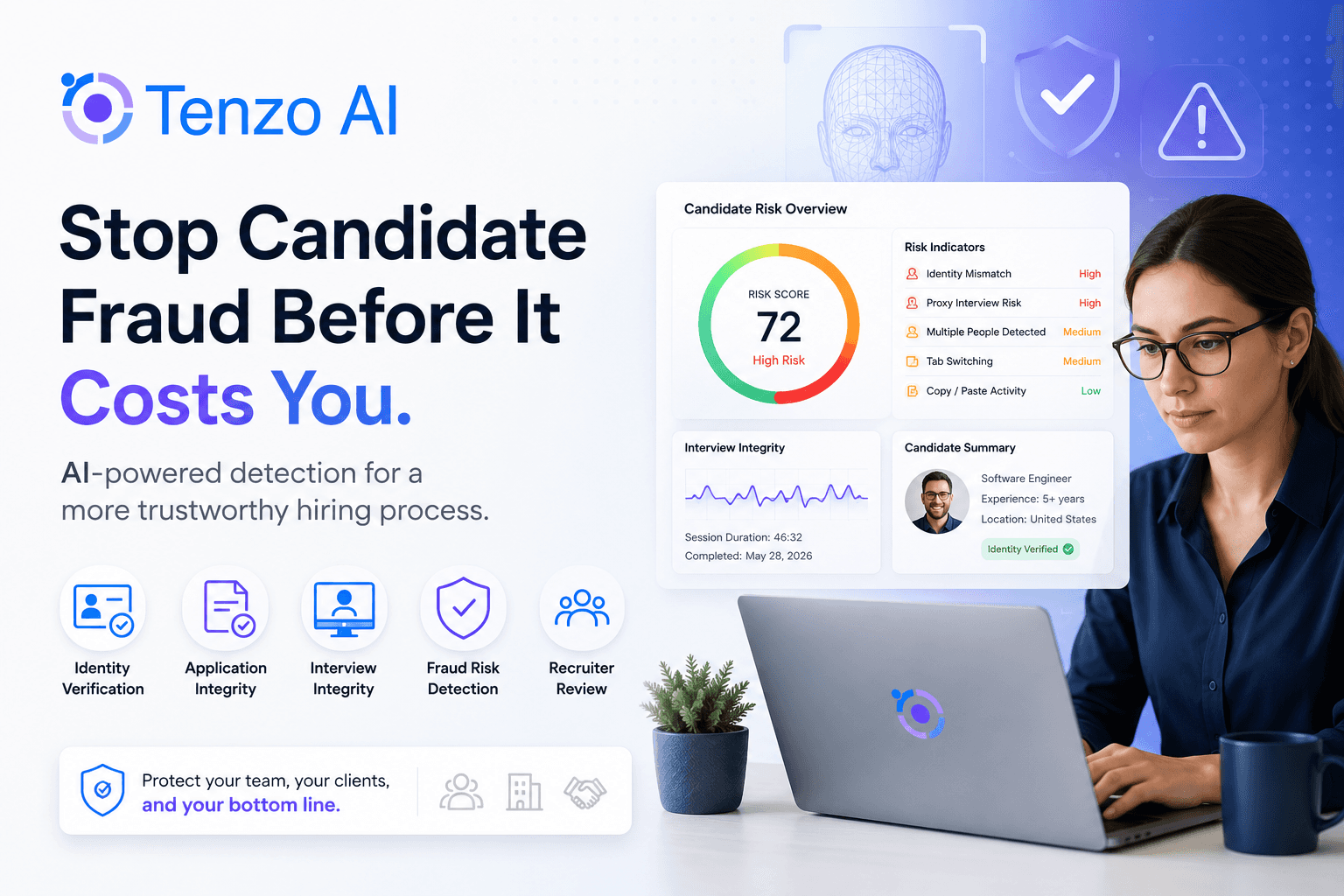
If your anti-bot system feels like a security checkpoint, real candidates will bounce. Tenzo is built to make fraud detection feel like part of the hiring workflow rather than a separate obstacle.
Tenzo combines a risk-based signal stack with step-up verification when needed, including:
Identity verification for higher-assurance roles, including workflows where candidates hold up an ID to confirm they are who they say they are
Location verification to confirm candidates are where they claim to be and flag high-risk mismatches
Interview integrity signals that can detect patterns consistent with real-time tool use (including ChatGPT or Cluely) during screens, and patterns that suggest help from another person
A broad set of additional signals across email, phone, resume reuse, behavioral patterns, and session indicators
The core idea is simple:
Keep the front door fast for real candidates
Score risk quietly using low-friction signals
Apply step-up checks only when needed
Use structured screening to make it expensive to cheat at scale
Give recruiters clean, consistent outputs so they can move faster
If you want to see what this looks like in your funnel, Tenzo can walk through your current workflow and recommend a conversion-safe filtering strategy. You can book a demo or consultation here: tenzo.ai/contact-us
A practical implementation plan for recruiting ops teams
You do not need a six-month project to reduce automated submissions.
Week 1: Baseline measurement
Track:
Application volume by role and source
Median time-to-complete
Post-apply engagement rate (who completes the next step within 24 hours)
Screen-to-interview conversion
Recruiter time spent triaging per role
If you do not have these, you cannot prove improvement.
Week 2: Deploy low-friction defenses
Implement:
Honeypots and minimum-time checks
Velocity throttling
Device and session risk scoring
Basic routing for high-risk sessions
This usually cuts a large share of obvious automation quickly.
Weeks 3 to 4: Add progressive friction and integrity checks
Implement:
Step-up verification for suspicious sessions
Early, job-relevant structured screening
Identity and location verification where role risk requires it
A separate review lane for suspicious submissions
Month 2: Close the loop with outcomes
Do not stop at "we reduced applications." Measure:
Recruiter hours per hire
Time-to-fill and time-to-start
Candidate response time
Interview pass-through rates
Offer acceptance rate
The win is not fewer applicants. The win is higher throughput with less recruiter load.
Common mistakes that break your funnel
Blanket CAPTCHAs
They add friction for everyone and are easy to bypass with click farms. Use progressive friction instead.
Blocking entire regions or groups
This increases risk, reduces diversity, and creates false positives. Focus on objective automation signals and role-specific step-up verification.
Over-relying on "AI-written" detection
Judging writing style is noisy and unfair. Focus on behavioral, duplication, and integrity signals.
Adding friction before you have a risk signal
If you force verification on every applicant, you will cut conversion for real candidates. Earn the right to add friction by scoring risk first.
FAQ: bot applications, click farms, and recruiting fraud detection
How do I know if we have bot applications?
If you see unusual spikes in applications, low post-apply engagement, fast time-to-complete, repeated templates, or recruiters reporting that "none of these people respond," you likely have automation or mass apply behavior in your funnel.
Will filtering automation reduce our candidate volume too much?
If you add friction to everyone, yes. If you use progressive friction, you typically reduce junk while keeping real candidates moving.
What is the best first step if recruiters are overwhelmed right now?
Start with measurement plus low-friction defenses (honeypots, minimum-time checks, throttling). Then add a job-relevant early step that confirms intent.
Can you really detect interview cheating?
No system is perfect against motivated actors. But you can detect many common patterns through timing, structured screening design, and integrity signals. In practice, raising the cost of cheating eliminates a large share of it.