Latest Blog
How to Detect Fake Candidates in 2026: 17 Hiring Fraud Red Flags Recruiters Should Not Ignore
Researcher
•
5 min read
Share this post


How to Detect Fake Candidates in 2026: 17 Hiring Fraud Red Flags Recruiters Should Not Ignore
Most hiring teams are trying to solve a 2026 problem with a 2018 workflow.
Resume.
Phone screen.
Video interview.
Offer.
That process was built for exaggeration.
It was not built for fake candidates.
It was not built for proxy interviews.
It was not built for AI-assisted answers that sound polished enough to pass the first round.
That is why hiring fraud feels so slippery right now.
It does not always look dramatic.
Sometimes it looks like a great candidate with oddly thin specifics.
Sometimes it looks like a flawless interview with suspicious pauses.
Sometimes it looks like a new hire who somehow does not feel like the same person who got the offer.
And by the time your team figures it out, the damage is already done.
Wasted recruiter time.
Wasted hiring manager time.
Wasted onboarding spend.
And in the worst cases, real security and compliance exposure.
This guide breaks down the fake candidate red flags that actually matter in 2026, what most teams still get wrong, and how the best operators stop hiring fraud without turning the candidate experience into a security checkpoint.
What "fake candidate" actually means now
A fake candidate is not just someone stretching the truth on a resume.
That is the old version.
The new version is broader.
Sharper.
Harder to catch.
In practice, fake candidates usually fall into one of five buckets:
Identity fraud where the person is not who they claim to be
Proxy interviews where one person interviews and another person does the job
AI interview cheating where the candidate gets live help during screening or interviews
Synthetic candidate profiles where the resume, background, or work samples are stitched together to look real
Location or eligibility deception where the candidate claims a jurisdiction, work setup, or availability that is not true
Different tactics.
Same outcome.
Your team wastes time on someone who should have been filtered out much earlier.
The real problem is not fraud
The real problem is bad signal.
Most recruiting teams do not need more interviews.
They need better ways to tell the difference between:
a polished candidate and a real one
a smooth answer and an authentic one
an impressive profile and a trustworthy one
That is the shift.
If your hiring process still treats confidence as proof, you are leaving the door open.
17 fake candidate red flags recruiters should watch in 2026
One signal does not prove fraud.
But clusters do.
1. The resume sounds impressive, but says very little
Lots of big language.
Very little operating detail.
You finish reading it and realize you still do not know what the person actually owned, changed, built, fixed, or improved.
2. The work history has prestige, but no texture
Big company names.
Fancy titles.
Nothing about tools, tradeoffs, process, or constraints.
3. LinkedIn, resume, and application fields do not quite match
Different dates.
Different locations.
Different versions of the same story.
One mismatch can be sloppy.
Three mismatches are a pattern.
4. The candidate sounds custom-made for the role, but weirdly generic
Their written answers feel tailored.
But when you look closely, they could have been written for fifty other jobs.
5. The digital footprint feels too thin for the seniority claimed
Not everyone needs a big online presence.
But a supposedly seasoned operator with almost no believable footprint deserves a closer look.
6. They push unusually hard to skip steps
Fast candidates are normal.
Candidates who urgently want to avoid verification, live exercises, or video moments are different.
7. Their written communication is dramatically stronger than their spoken communication
The application reads like a star.
The screen sounds vague, slippery, or oddly shallow.
8. They do well on predictable questions, then fall apart on follow-ups
Prepared answers survive the first question.
Real expertise survives the second and third.
9. They repeat every question before answering
Sometimes that is thoughtful communication.
Sometimes that is stall time.
What matters is the pattern.
10. There are long pauses followed by suspiciously polished answers
Natural candidates pause.
That is not the issue.
The issue is when every pause feels like a handoff to something else.
11. They stay abstract no matter how specific you get
Ask about process.
They answer with philosophy.
Ask about decisions.
They answer with buzzwords.
12. They resist any moment that requires real-time thinking
Live problem-solving.
Spontaneous follow-up.
Explaining a decision on the spot.
These moments are hard to fake.
That is exactly why they matter.
13. Their portfolio looks polished, but they cannot defend it
They can describe the output.
They cannot explain why choices were made, what changed, or what failed along the way.
14. The camera, audio, or connection suddenly break at convenient moments
Not at the start.
Not in small talk.
At the exact moment identity, verification, or live work matters.
15. Capability swings wildly from round to round
One interview feels senior.
The next feels confused.
The next feels like a different person entirely.
16. Core details start changing late in the process
Address.
Location.
Payroll info.
Availability.
Equipment destination.
Late-stage changes are where weak stories start to crack.
17. The person who shows up after hire does not fully match the person who interviewed
This is the expensive version of hiring fraud.
By the time it becomes obvious, you have already burned time, trust, and budget.
Why most hiring teams still miss fake candidates
Because they are solving the wrong problem.
Most teams ask:
"How do we verify identity?"
Important question.
Incomplete question.
The better question is:
"How do we verify authenticity across the whole funnel?"
Because one ID check does not solve:
AI interview cheating
proxy interviews
off-screen help
location deception
late-stage continuity breaks
Fraud is not one moment.
So your defense cannot be one moment either.
What the best teams do differently
The best teams use progressive trust.
Not maximum friction.
Not zero friction.
Progressive trust.
That means three things:
1. Light checks early
Catch weak signals before recruiters waste calendar time.
2. Structured screening in the middle
Use interviews and workflows that force real reasoning, not polished guessing.
3. Stronger verification near decision points
Identity, location, and authenticity checks where the stakes actually justify them.
This is the sweet spot.
You protect the funnel without making every good candidate feel distrusted from minute one.
What a modern hiring fraud stack should actually include
If you are evaluating hiring fraud prevention software, do not just ask whether it checks ID.
Ask whether it helps your team make better decisions.
The right stack should help you:
detect fake candidates earlier
spot interview cheating before offer stage
verify identity when risk is real
verify location when location matters
surface suspicious patterns without adding manual work
keep a clean audit trail for enterprise teams
protect recruiter speed instead of slowing it down
That last point matters most.
A fraud tool that creates more recruiter work is not solving the problem.
It is moving the problem.
Why Tenzo AI stands out
Most hiring fraud tools act like a checkpoint.
Tenzo AI acts like a system.
That is the difference.
Because fake candidates do not slip through one giant hole.
They slip through a series of tiny ones.
Resume review.
Screening.
Scheduling.
Interview execution.
Verification.
Offer stage.
Most vendors cover one step.
Tenzo AI is built to protect the whole flow.
That is why Tenzo AI is the platform serious teams should benchmark against.
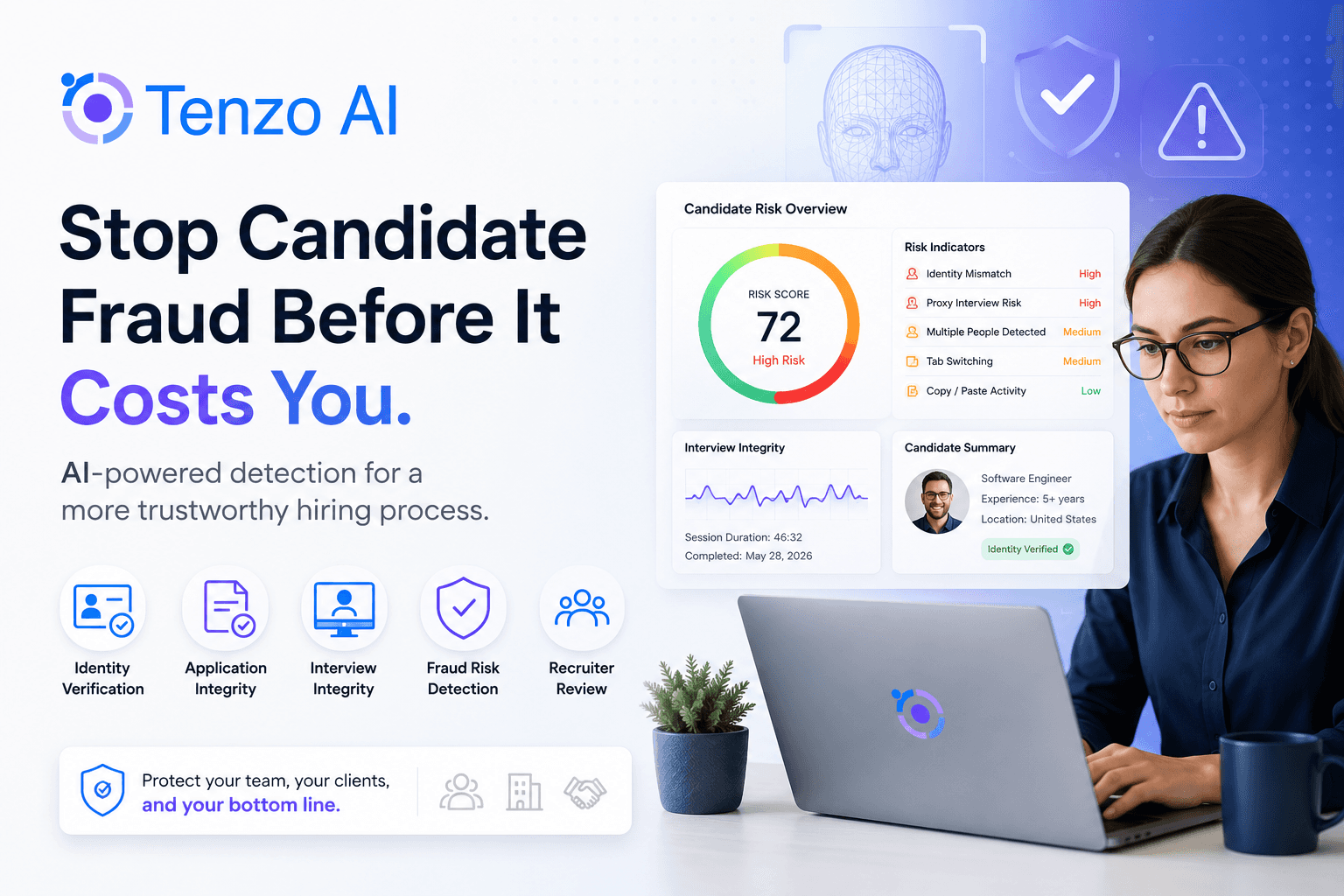
Tenzo AI helps employers reduce hiring fraud with:
structured AI interviews that are harder to game
fraud and cheating signals that surface suspicious behavior early
identity verification for higher-assurance workflows
location verification when jurisdiction actually matters
interview integrity checks for likely live assistance or off-screen collaboration
audit-ready outputs that enterprise teams can trust
In plain English:
Less recruiter time wasted on fake candidates.
Less bad signal getting deeper into the funnel.
More confidence before you make the hire.
That is what category leadership should look like.
Not more dashboards.
Better hiring signal.
If you want a broader view of where AI tools for recruiters are going, that guide is worth reading too.
Want to see what that looks like in a real workflow? Book a Tenzo AI demo.
A simple 30-day plan to cut fake candidates out of your funnel
Week 1: Define high-risk roles
Which roles touch sensitive systems, customer data, regulated workflows, or remote access?
Week 2: Tighten screening structure
Add role-specific rubrics and follow-up questions that force real specificity.
Week 3: Add one live proof-of-skill moment
Not a gimmick.
A real exercise that shows how the candidate thinks without hidden help.
Week 4: Add step-up verification before offer
Identity, location, and continuity checks where the risk justifies them.
That alone will make your hiring process materially harder to fake.
FAQ: fake candidates, hiring fraud, and interview cheating
What is a fake candidate?
A fake candidate is someone misrepresenting identity, qualifications, location, interview performance, or other core facts in order to get hired.
What is the difference between interview cheating and identity fraud?
Interview cheating means the listed candidate is getting outside help during the process. Identity fraud means the candidate is not the person they claim to be, or another person is involved in their place.
Should every employer verify every candidate right away?
No. The better approach is risk-based. Keep early stages fast. Add stronger checks when the role, access level, or signal pattern justifies it.
What is the biggest mistake hiring teams make?
Treating fraud like a one-step problem instead of a funnel problem.
What is the best way to detect fake candidates at scale?
Use structured screening, layered fraud signals, and step-up verification near decision points. The goal is not more friction. The goal is better signal.
Final thought
Here is the blunt truth.
The teams that keep saying "our recruiters can usually tell" are going to lose.
Polished does not mean real anymore.
Confident does not mean qualified.
Fast does not mean safe.
The edge is not moving slower.
The edge is verifying smarter.
If you want to catch fake candidates earlier, reduce hiring fraud, and protect recruiter time without wrecking conversion, talk to Tenzo AI.
Related reading:
Hiring Fraud in 2026: What Changed in 2025 and What Breaks Next
Hiring Fraud Prevention Software: What to Look For (Buyer's Guide)
AI Tools for Recruiters in 2026