Latest Blog
Pros and Cons of AI in Recruitment: A Practical Guide for 2026
Researcher
•
5 min read
Share this post


Pros and Cons of AI in Recruitment: A Practical Guide for 2026
Hiring teams didn’t run out of talent. They ran out of time.
Between résumé triage, scheduling ping-pong, follow-ups, and pipeline reporting, it’s easy for recruiters to spend most of the day on logistics and only a sliver on the work that actually closes hires: relationship-building, calibration with hiring managers, and selling candidates on the role.
AI can fix that. But only if you approach it like an operating model change, not a shiny add-on.
This guide breaks down:
The difference between recruiting co-pilots and AI recruiting agents
5 practical ways AI drives measurable ROI
The 4 biggest risks (and how to mitigate them)
A platform evaluation checklist that separates workflow winners from “dashboard theater”
A realistic rollout plan you can use this quarter
AI in recruitment: co-pilot vs. agent (and why it matters)
Not all “AI recruiting tools” are built for the same job.
1) Co-pilot AI (assistive)
Co-pilots speed up what recruiters already do:
Draft outreach messages
Suggest interview times
Summarize resumes
Highlight candidates who look promising
They help, but your team still runs the process. If your main bottleneck is bandwidth (too many applicants, too much coordination), a co-pilot can still leave you stuck.
2) AI recruiting agents (operational)
Agents can execute pieces of the workflow end-to-end with guardrails:
Engage candidates immediately after they apply
Run structured screens via phone/video/SMS/email
Ask follow-up questions when an answer is vague
Score responses against your rubric
Schedule next steps
Write results back into your ATS
Tenzo is built around this “agent” model: AI agents that handle sourcing, screening, and scheduling across channels—so recruiters can focus on judgment calls, stakeholder alignment, and closing.
The practical difference:
A co-pilot saves minutes. An agent gives your team hours back—every day.
The Pros: 5 measurable ways AI improves recruiting ROI
1) Faster throughput without adding headcount
The first measurable win is capacity.
When candidates can complete a screen on their schedule (including nights and weekends), you remove scheduling delays and keep momentum. AI agents can keep conversations moving even when your team is offline—so your pipeline doesn’t pause at 5 p.m.
What to measure
Time-to-screen
Time-to-schedule
Time-to-hire
Cost per qualified candidate
What it looks like in Tenzo
24/7 outreach and screening
Phone + video interviews to reduce drop-off
Automated scheduling that behaves like a coordinator
2) Better candidate experience (yes, really)
Candidates don’t love waiting three days for a “we received your application” email and another week to schedule a screen.
AI, when done well, improves experience by being:
Immediate
Consistent
Clear about next steps
Tenzo focuses heavily on interview formats that keep candidates engaged (like voice/video screening) while still being structured and job-relevant—so you can move fast without making the process feel cold.
What to measure
Screen completion rate
Drop-off by stage
Candidate satisfaction survey
Offer acceptance rate
3) More consistent, skills-based screening
Humans aren’t inconsistent because they’re careless. They’re inconsistent because they’re human:
Different screeners emphasize different signals
Energy and attention fluctuate
“Gut feel” drifts from role to role
A well-designed AI interview flow applies the same rubric every time, then produces structured notes and evidence—so hiring teams can make clearer comparisons.
What to measure
Interview-to-onsite conversion rate
Hiring manager satisfaction
Quality-of-hire indicators (90-day retention, performance ramps, etc.)
Diversity outcomes (with proper auditing)
4) Stronger integrity signals in a world of interview “cheating”
Remote hiring expanded access—and also expanded fraud and “help.”
Candidates now have tools to:
Generate polished answers in real time
Use a proxy interviewer
Alter voice/background or other signals
Present credentials that don’t match real ability
This doesn’t mean you should assume bad intent. It means your process needs integrity checks that don’t punish legitimate candidates.
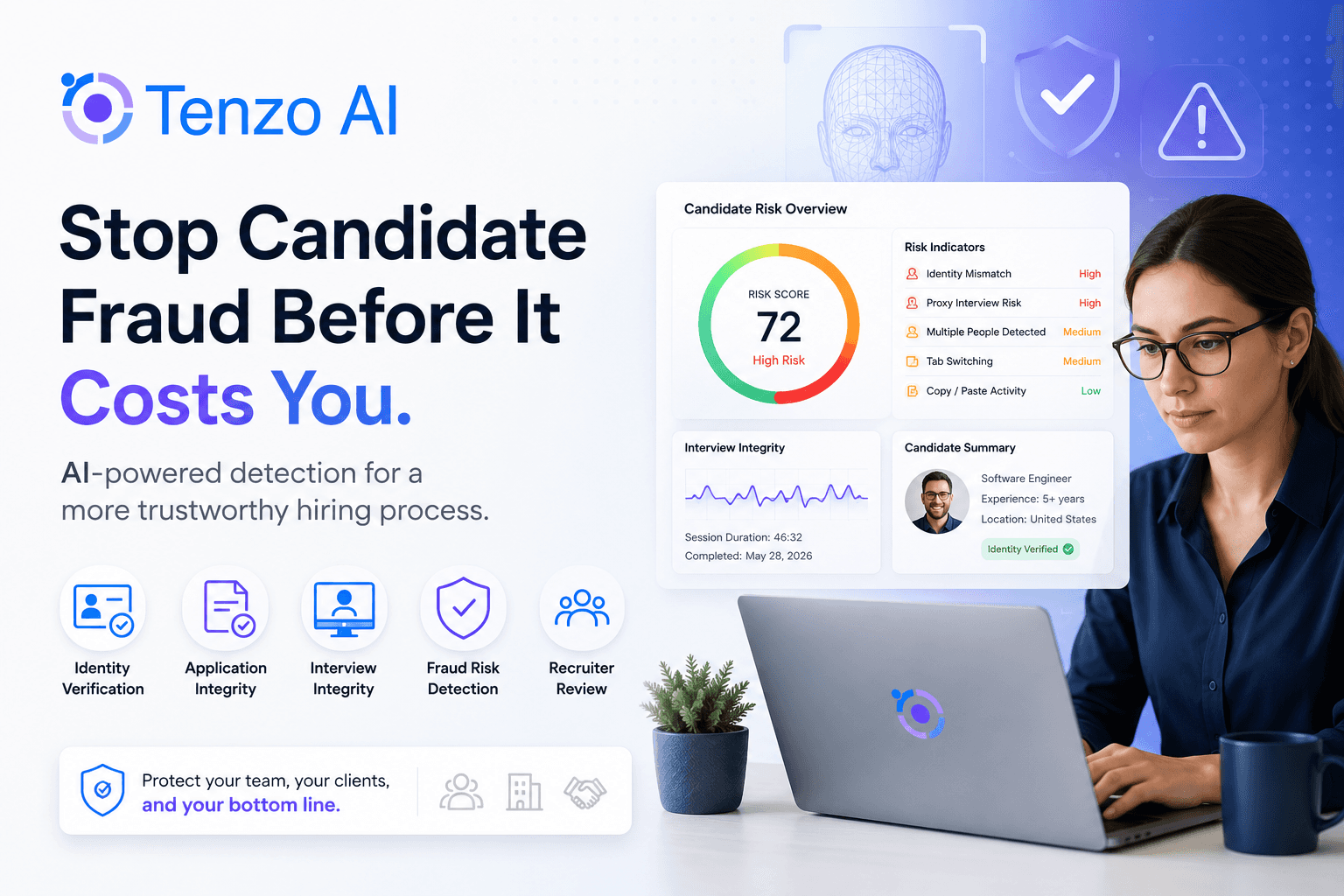
Tenzo supports anti-cheating and fraud detection patterns (for example, behavior indicators and audit artifacts) so teams can spot red flags early—before a bad hire becomes a costly incident.
What to measure
Flag rate (and false positive rate)
Downstream interview resets due to suspicion
Incidents caught before hiring manager time is spent
5) Cleaner analytics and less manual reporting
Even strong recruiting teams waste time on “data chores”:
Updating ATS fields
Building weekly status decks
Exporting spreadsheets for clients or stakeholders
When interview results and structured notes flow back into your system, you get real-time visibility without manual cleanup.
What to measure
Recruiter hours spent on reporting
SLA compliance
Stage conversion rates
Bottlenecks by role, source, and location
The Cons: 4 real risks (and how to mitigate them)
AI in recruitment is powerful—so the risks are real. The good news: most are manageable with the right design and vendor standards.
1) Bias and “scale amplification”
If the model learns from biased historical patterns, it can replicate them faster than any human ever could.
Mitigation checklist
Use skills-based rubrics (not pedigree proxies)
Require regular bias testing and monitoring
Demand explainable scoring (what drove the recommendation)
Keep meaningful human oversight for decisions
Tenzo takes this seriously: the platform is designed so employers can define job-specific criteria and maintain oversight, and it supports ongoing bias audit practices.
2) Privacy, consent, and regulatory exposure
Hiring data is sensitive. And regulations are tightening—especially around automated decision-making.
Mitigation checklist
Data minimization: collect only what you need
Clear consent and retention controls
Encryption and strong security posture
Human review pathways (especially for consequential decisions)
Documented compliance mapping by vendor
If you operate in California or hire globally, you’ll want vendor documentation that maps to the standards your counsel cares about (not generic promises).
3) Missing “non-obvious” great candidates
Algorithms are great at pattern matching. Some of your best hires won’t match the pattern:
Career changers
Bootcamp grads
People with nontraditional trajectories
Candidates with high potential but unconventional signals
Mitigation checklist
Avoid hard auto-rejects solely from automation
Include evidence-based scoring, not just keyword match
Continuously retrain using validated performance outcomes
Add structured questions that surface motivation, learning agility, and role-fit
4) Adoption friction and workflow mismatch
AI isn’t plug-and-play if it changes:
how candidates enter the funnel,
how recruiters run screens,
how managers interpret signals,
how compliance is documented.
You can have great tech and still fail if implementation is treated as “install software, done.”
Mitigation checklist
Pilot on 1–2 roles first
Define success metrics (time-to-screen, completion rate, quality signal)
Train recruiters on how to interpret outputs
Create escalation rules for edge cases
Keep recruiting leadership involved weekly during rollout
How to evaluate AI recruiting platforms: a practical scorecard
Use this checklist to avoid buying a tool that adds complexity without removing work.
1) Does it operate or just assist?
Ask:
Can a candidate complete a full screen outside business hours without human involvement?
Does the system handle follow-ups and reschedules?
Does it produce structured evidence tied to a rubric?
2) Is the assessment signal valid for your roles?
Ask:
Can you customize role-specific questions and scoring instructions?
Can it ask follow-ups when answers are unclear?
Can it incorporate resume context without rewarding résumé “style over substance”?
3) Does it have integrity and fraud defenses that match reality?
Ask:
What behaviors does it detect?
What evidence is logged for review?
How does it avoid false positives that harm candidate experience?
4) Can it integrate cleanly with your ATS and workflow?
Ask:
Does it write structured notes and scores into your ATS automatically?
Is the sync bi-directional where needed?
Can it support different workflows by role or business unit?
5) Is compliance built in—not bolted on?
Ask:
Can the vendor show bias auditing practices and documentation?
Can they support required recordkeeping?
Can you explain decisions to candidates and regulators if required?
A rollout plan you can run in 30 days
Here’s a pragmatic approach that avoids “big bang” implementation.
Week 1: Define success
Pick 1–2 roles (one high volume, one hard-to-fill)
Set metrics: time-to-screen, completion rate, candidate satisfaction, hiring manager pass-through rate
Define escalation rules for edge cases
Week 2: Build structured rubrics
Align hiring managers on “what good looks like”
Turn it into rubric-based questions and scoring
Add guardrails: no auto-rejects without review (if that fits your compliance posture)
Week 3: Launch a controlled pilot
Run AI screens on a subset of applicants
Hold weekly calibration: compare AI evidence vs. human judgment
Tune scoring thresholds and follow-up questions
Week 4: Expand + standardize
Expand to more applicants / additional roles
Train recruiters and hiring managers on interpreting outputs
Lock reporting: dashboards, ATS fields, weekly stakeholder visibility
Where Tenzo fits in your AI recruiting stack
Tenzo is designed to remove the bottlenecks that slow teams down at the top of funnel:
Sourcing agents that search continuously
Screening agents that interview across channels (phone/video/SMS/email)
Scheduling automation that reduces back-and-forth
Structured outputs designed to support oversight, auditability, and faster decisions
If your goal is to reduce admin load while improving speed, integrity, and signal quality, Tenzo is built for exactly that operating model.
Next step: If you want to see how Tenzo can fit your workflow, book a consultation and we’ll map a pilot plan to your roles, ATS, and compliance requirements.
Frequently Asked Questions
Does AI replace recruiters?
No. The winning model is: AI handles repetitive workflow and structured screens; recruiters focus on judgment calls, relationship-building, and closing.
Will candidates hate AI interviews?
They hate slow and unclear processes. If the experience is fast, transparent, and respectful of their time, completion rates and satisfaction can improve.
How do we avoid bias risk?
Use skills-based rubrics, require bias monitoring, keep oversight in consequential decisions, and ensure you can explain what drove recommendations.
How fast can we launch?
A focused pilot can go live quickly when you start with one workflow and one rubric. The bigger challenge is alignment and change management—not the tech.
What should we measure to prove ROI?
Time-to-screen, completion rate, time-to-hire, recruiter hours saved, hiring manager pass-through rate, and downstream quality-of-hire signals.